Showing posts with label humpback whale. Show all posts

Wednesday, 11 May 2016

Whale Watching in the Azores

After taking people ‘virtual whale watching’ in the Azores for the last three WhaleFest events, I felt it was finally time to set foot on the archipelago myself. But when to go? The virtual whale watching experience at WhaleFest had focused on the sperm whale. For the people of the Azores this is The whale; when they talk about whales on the island it is about the sperm whale. This is the whale they hunted until the mid-1980s, still using traditional methods. They are the whales that are intricately intertwined with the culture and history of the islands. They are the whales that are present year round. So I could go any time, weather permitting. But speak with any of those affectionately known as ‘whale geeks’ (and I count myself honoured to be included in this) and they talk of spring. Of baleen whales. At this time of year ocean giants such as blue, fin and sei whale migrate past the Azores on their way north. At the same time there is a bloom of phytoplankton leading to large numbers of zooplankton (tiny animals like krill) aka whale food! My mind was set, spring it would be with the hope of encountering these magnificent giants. 

And so we arrived on the island of Faial, first week of May, smack bang in the middle of the spring migration. The charm of the island captured me from the start; dominated by the caldeira, the huge crater of an extinct volcano, brilliant green and lush vegetation slopes down to meet dark volcanic rocks, black sandy beaches and the glistening azure blue sea. In the charming town of Horta the traditional buildings are white, with coloured borders to the windows and doors, dark shutters and topped off with red tile roofs. Those that break the trend of white tend to be painted a pale, pastel colour, maybe yellow or blue. The streets are cobbled with dark stone, and along the sidewalks patterned with white stone into writing or pictures; a windmill, boat or whale. Madeiran wall lizards scamper over walls made of volcanic rock, its surface characteristically peppered with small holes. The tree lined seafront promenade overlooks the marina where numerous yachts line up, busy but not nearly as busy as it will become. The town is a traditional stopover for transatlantic sailors, many of which have left their mark with paintings on the marina steps. Looking east over the channel the impressive sight of the eponymous Pico which for the majority of our stay has at least some cloud cover, on occasion completely obscured while even on our clearest day a band lies just beneath its peak. 

Horta (Photo: Lee Barber)

But as captured as I am by the island, it is the sea and the whales I am here for. 

My first two trips are onboard the RIB Risso with Horta Cetaceos. Trip one and our skipper Pedro expertly guides the boat over the swell and out to the south of Faial. He is guided by the lookouts, a throwback to the old whaling days, now these sharp eyed watchers call out all species for whale watchers. Pedro uses the speed of the boat to take us quickly to the locations, then slows and carefully manoeuvres us around not one but three different species of baleen whale. First a humpback whale, with tail fluke lifted in greeting it seems. Then not one but two majestic fin whales, of which I am so used to seeing at a distance, high up from ferries or cruise ships, now, low to the water I am struck by their beauty, gracefully slipping through the waves. Then from the grey blue waves surfaces a magnificent blue whale. If you thought fin whale looked big from a small boat, the blue blows them away. The blow is huge, followed by a massive head and long, long, long body. Finally a tiny dorsal fin breaks the surface followed by a short tail stock and then whale disappears beneath the vast ocean. In a word it is awesome!

The awesome blue whale!

Trip two and Pedro heads north of Faial. Conditions are not great for the spotters, with high cloud the ocean is a calm, silvery grey that makes it harder for them to spot the blows. But they are seeing something, a back of a whale, a fluke print. And so we go. We are distracted though. In the calm conditions and with Cory’s shearwaters everywhere we are distracted by a group of bottlenose dolphins and then of common dolphins. Once again being so low to the water gives me a new perspective on both of these species, a perspective I must say I loved! Finally we arrive in the area where the spotter has seen this whale. Still it is down to us on the boat to find it. Ahead I glimpse something breaking the surface. No blow, just a dark back and small dorsal fin. It is a whale but a small one. We approach carefully and are treated to views of a minke whale. A whale that is very familiar to me, but of which sightings in the Azores are more unusual. With reports of larger whales we head back. It is those majestic fin whales again. We watch as a whale surfaces four or five time’s then dives for around 6 minutes. With Pedro’s skill and experience we are able to manoeuvre close enough to give the whale space, but to allow us to see the characteristic white lower jaw on the right side. With the sun beginning to break through the cloud the sea turns an oily blue colour and on our way back to the marina we encounter the bottlenose dolphins again. The group is chilled, spread out and relaxed. They approach and through the deep blue you can see their full length as they ride alongside the boat. It is magic to be so close to such beautiful animals in the wild. 

The white right lower jaw of a fin whale

My final trip is a full day with Whale Watch Azores and whale biologist Lisa Steiner. After a night of wind and rain the day dawns with a clear sky, just the odd white fluffy cloud obscures the vast blue sky and skirts the midriff of Pico. Despite the pickup in the wind and the odd white cap the sea conditions are not bad and at times the wind drops away leaving a stunning blue ocean. This time we head right along the coast of Pico on the trail of reports of a blue whale. Once again we encounter welcome distractions. The first a totally chilled out humpback whale that simply cruised along just under the water’s surface. From the slight elevation of the catamaran’s bow we can see the almost white glow of the whale’s pectoral fins. Then we encounter common dolphins, racing through the blue waves and sweeping this way and that under the bow of the catamaran. It is one of those moments where the water has calmed and it is almost glassy in places. Further on and the distinctive movement of striped dolphins catches our eye. They speed through the water, cutting the surface with a spray of water or leaping tremendously high out of the water. Then finally we meet up with a couple of other boats and from the surface a blast of water shoots high into the air. It is the blue. What follows is an awesome encounter. Again the slight elevation allows us to see the vast blue shadow of the whale beneath the water before it breaks it to breath. The routine is the same again, surface four or five times then down for around 8 minutes. But this time, this whale raised its fluke out of the water every time it dived for its deeper dive! Not all blue whales lift their tail flukes, and not all every time they dive! With each lift of the tail a whoop would escape my lips, as unstoppable as the blue whale itself. The trip is topped off with ‘whale’ riding dolphins. As they approach vessels to ride the pressure wave the bow creates, dolphins will often ride the wave a whale creates as it moves through the water. I have heard of it, but this was the first time I had seen it. Common dolphins would surface and then just behind a fin whale would surface! 

Awesome tail fluke of a magnificent blue whale

It was a long trip back to Horta, but I felt at peace sitting on the bow of a boat, watching waves, Cory’s shearwaters and even a couple of loggerhead turtles, remembering each detail of all of the encounters I had had during my superb trip to the Azores. I can see why this group of nine islands in the middle of the Atlantic is a mecca for whale watchers and is being considered for Whale Heritage Site status by the World Cetacean Alliance. 

I will be back. Summer dolphins and the sperm whales that have eluded me this trip are calling….

Photo Gallery by QuickGallery.com

Wednesday, 16 July 2014

Arctic Explorers

I awake from my slumber to breath taking views of Spitsbergen. Tall, dark, sheer mountains with blankets of snow and smooth white glaciers reach a sea that is calm as a millpond. The only ripples are created by the hundreds of auks. Everywhere I look there are Little Auks, Brünnich’s Guillemot, Black Guillemot and Puffins, either sitting on the water or streaming by in low flying groups. Amongst them are Fin Whales, surfacing against the stunning, mountainous backdrop. It is paradise. Our first stop is the town of Longyearbyen. An industrial place, with mines carving across the mountainside, looming over the houses that to be honest look a little worn against the grey skies. Throughout the town Snow Bunting sing, males in full breeding regalia flit from building to tundra to rock. I brave the Arctic Terns that nest right next to the road, I do not blame them for swooping and attacking me in protection of their precious eggs. Right next to the sign warning me to go no further without armed protection (this be Polar Bear country) I meet familiar birds, Grey Phalarope – known here as Red Phalarope – and Purple Sandpiper in stunning breeding plumage. Eider nest right next to a compound filled with howling Huskies. Later as the ship heads back out of the Fjord, sunshine starts to spill through gaps in the cloud cover, and dazzling in this light are the blows of a group of Fin Whales. Astounded I watch these whales milling, not moving fast or feeding, but resting. Amongst them there are clearly younger, smaller animals, and in amazement I watch as one lifts its tail fluke out of the water, a behaviour I have seen many times in Humpback Whale and Sperm Whale, but that is more unusual in this, the second largest animal on the planet.

Fin Whale off Spitsbergen

Our second stop is probably the most stunning, this was the day that the beauty of this remote, wild landscape was truly revealed in glorious splendour. Brilliant blue skies reflected in blankets of snow which covered the research town of Ny-Ålesund. A sheer, cracked wall of blue and white ice rears up where glacier meets sea. Immense mountains surround the town whose houses are brighter and feel more welcoming. Early in the day a Humpback Whale is sighted feeding in front of the glacier at the end of the bay. All day it works its way to and fro in front of glacier and mountains, feeding amongst the meandering ice bergs. Mid-afternoon and the whale has worked its way right in front of the stationary ship. Bubbles appear, rippling the calm blue water, and with a whoosh of breath the whale appears, throat and mouth distended as it gulps fish and water in one go. It dives with a flick of its tail fluke, and moves a little further on. The Arctic wildlife on land is just as impressive; amongst the snow and houses, the raucous screeching crescendo of Arctic Terns once more signals their intent to protect their nests by any means. Reindeer wander across blankets of snow. Long-tailed Duck, Snow Bunting and Barnacle Geese mingle on the tundra with Purple Sandpipers and Turnstones. Long-tailed, Arctic and Great Skua careen through flocks of Kittiwakes and terns that are feeding just off the shore. It is hard to say goodbye to such a dramatic and beautiful place as the ship headed away once again surrounded by Little Auk and Brünnich’s Guillemots.

Humpback Whale lunge feeding 

The final stop is Magdalena Bay, the most northerly, remote and wild of all the places we visit. Here the mountains are closer, looming perhaps ominously above a small circular bay where once again icebergs swirl. Glaciers sweep down between the sheer cliffs and rocky screes. Closer inspection reveals thousands of Little Auks swarming around the mountainside where they are nesting amongst the rocks. The ship nestles itself at anchor amongst the icebergs and we spend a morning watching the Auks, soaking up the wilderness. Again it is hard to leave such a raw and beautiful place, but as we leave with the smooth rippling waters giving way to waves and white caps, a sudden movement alongside reveals seven or eight Walrus! They surge up through the waves, tusks bared, tumbling over each other as the ship headed out to sea.

Walrus!

And so we head south, our adventures on Spitsbergen itself were over, but its incredible waters still had some surprises in store for us…

Monday, 4 November 2013

A Wild Whale Chase

It’s not every day your colleague comes into work and says he has seen a humpback whale from his sofa! And living in Norfolk this absolutely never happens as this whale has never been recorded here, that is until now! 

Humpback whales are widely distributed throughout the world's oceans, undertaking long distance migrations between winter tropical breeding grounds and high latitude feeding grounds during the summer. Over the last 10 years or so their numbers worldwide have also been increasing. Good news as they recover from commercial hunting.

The unmistakable humpback whale (not the Norfolk whale but a humpy non the less)

In British waters the humpback whale is an unusual sight, although the number of sightings is increasing and it is now regularly recorded along the western coasts of Britain, from Shetland, the north Irish Sea and the western approaches to the Channel. These individuals are likely to be part of the population that migrates from the west coast of Africa, north to off the coast of Iceland and Norway (Sea Watch Foundation, 2012). There are also more and more reports of whales from the northern and central North Sea.

One of the great things about working for a department filled with marine wildlife enthusiasts is that we are all in the same ‘boat’ so to speak...we love watching whales and dolphins and when something like this turns up on your doorstep we have the flexibility to just go! Well I was going at any rate!


Stormy clouds and rain did not deter us as we wound our way along the narrow roads of the Norfolk coast. Reports of the whale were still coming in; it seemed to be feeding a short distance from the shore, slowly moving northwards. By the time we pulled up in the small village of Sea Palling the sun had broken loose, driving the cloud and rain away. Climbing up the sand dunes we were met with people carrying scopes, heading the other way. ‘It’s moved further north’ were the words, with which we did an about turn and headed back to the car. More winding roads and one diversion later we pulled into the windswept car park of Happisburgh and were greeted by a small crowd of people and their scopes. Surely a good sign.

Standing there at the top of a dune, gazing out at a murky North Sea, the sun casting various shades of blue across the choppy surface, and the guy standing next to me, his eye glued to his scope, finally shouts ‘there it is!’. Me with my binoculars scanning however could see nothing but waves, occasional spray and gannets. It was moving offshore, its blow merging with the white caps and without a scope there was not much hope. Maybe, for me, it was not meant to be.

Turns out this whale found the food and water off the Norfolk coast rather appealing. The next morning it was seen again, following the same route and pattern; close to shore moving northwards. We may miss it; it may be far offshore again by the time we get there; but if you never try, you never know; you can guarantee you won't see it sat at your desk. Such words swirl round my head as we drive back along the winding roads, this time to Horsey. Climbing the dunes once more and gazing out at a calm blue sea, we are greeted by the unmistakable blow, back and hump of a humpback whale! Taking no chances this time I have borrowed a telescope, and while at first it is close enough to see with the naked eye, gradually the whale moves further offshore and the scope lets me follow it....


Scoping out a humpback whale from the North Norfolk Coast

Wednesday, 25 September 2013

Kayaking with Giants

There is not a ripple to be seen. The only sound is the plop of a paddle as it dips into the water, the drip of sparkling droplets as it is lifted out and the gentle slap of the kayak as it glides through the smooth water. Spray jackets rustle as our arms slowly work moving the paddle at a steady rate. The deep blue ocean is so smooth it looks oily, swirling patterns created from innumerable shades of blue, black, green and purple. The deep green of the shoreline, an impenetrable wall of trees silently passes by. Wispy lichen hangs like tendrils from the branches, giving them an almost ghostly and eerie presence.

The beauty of Vancouver Island from a kayak

Across the still water a huge ‘whoosh’ breaks the silence, a whale surfacing to breathe. Louder, deeper somehow, longer than the Orca that call the straits and waterways off Vancouver Island home for the summer. This whale is bigger, much bigger. Scanning ahead, and around us, we hear a ‘whoosh’ again and this time see the ephemeral water droplets hanging in the air. We drift, watching, listening, and waiting. ‘Whoosh’ again, closer, this time and we see a dark, large body surface, arch its back and disappear. A humpback whale, one of the oceans giants, the size of a bus, circles our small, 6 foot long kayak. I feel no fear. This giant is searching for food, which for them is small shoaling fish, although I am glad to keep a respectable distance.

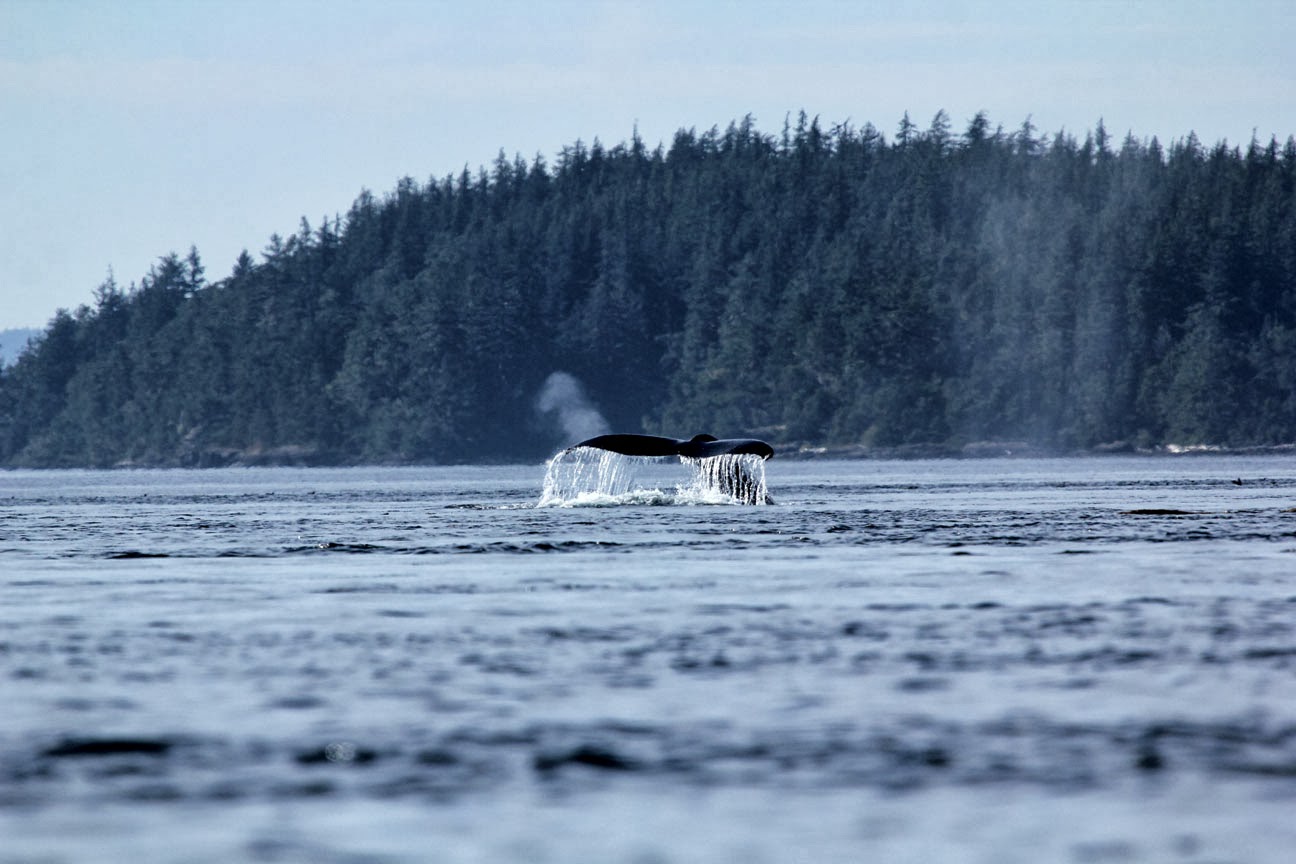
The whale surfaces again, and in the opposite direction another two whales surface almost simultaneously. There are now three working the area around us. The whale ahead breathes dips its body and gracefully lifts its wide, wing like tail out of the water, almost waving goodbye.

The majestic tail fluke of a humpback whale

But it is a brief goodbye. Birds circle, a sure sign of food being pushed to the surface of the water. We watch the commotion, listening to the raucous calls of the gulls. Suddenly the water erupts from beneath the birds as the humpback whale lunges upwards and out of the water, white water explodes everywhere. Mouth open wide the whale engulfs the entire ball of fish. For a moment it seems to pause, hanging in mid-motion, mouth open, it’s bristly plates of baleen hanging down from the huge top jaw. Beneath, the throat has ballooned allowing the whole shoal to be scooped up in one go. Slowly, sedately, the whale disappears beneath the waves, here it will push all the water out through those baleen plates where the fish will be trapped, like a filter, allowing the whale to wipe them clean with its huge tongue and swallow the food.

Humpback whale lunge feeding

Not even before the first whale had disappeared another surges up and out of the water, this time sideways, it’s long, white, knobbly pectoral fin (flipper) lifted up out of the water.

Everything briefly goes quiet before the each whale surfaces to breathe once more, lifts its tail and disappears to continue its search for food. We continue to sit, somewhat breathless from the whole encounter, listening and watching as time after time each of these whales continues to surface and feed…

another adventure with Kingfisher Wilderness Adventures....