Showing posts with label Orca. Show all posts

Friday, 15 May 2015

10 years to the day

Where have the last 10 years gone? 

10 years ago today I was sat on a rather lovely boat called Alpha Beta, bobbing around off the coast of the Isle of Mull. Fresh out of university I was spending the summer working as a volunteer for Sea Life Surveys, one of the longest running whale watch companies in the UK. This particular day was my day off, but that had not stopped me hopping on board for a couple of whale watches, off in search mainly of minke whales but with a range of whale and dolphins species, seals, basking sharks and a multitude of seabirds to encounter. I remember this particular trip more than any other. It was a rather cloudy day but the sea was reasonably calm. We’d done one trip and had headed out for a second. Sitting on the top of Alpha Beta, her broad white bow in front of me, dipping and rising a little with the waves I had gazed out at the silvery grey sea and the surrounding landscape that was quickly becoming very familiar to me. The Isle of Mull stretched out to my left, to my right in the distance the low lying island of Coll hovered on the horizon. Ahead the rugged coastline of Ardnamurchan, with its impressive lighthouse towering into the grey clouds. Beyond that I could still see the characteristic outline of the Small Isles, in particular Rum and Eigg (which always reminded me of a humpback whale). We were heading in, having encountered a good number of birds, and a couple of minke whales, one of which had surfaced just in front of the boat so that I could almost see down its blowholes as it surfaced, breathed and dived. It had been a good trip. Eri, who was guiding had kept the passengers engaged, all I had to do was sit back and enjoy.

Ardnamurchan lighthouse with the Isle of Eigg in the background

It was just as we were approaching the entrance to the Sound of Mull that one of the passengers commented that he thought is saw something, way over towards the Small Isles. I looked over, scanned, and something caught my eye. Something that at first did not really register. A tall, black, vertical ‘thing’ had risen out of the grey waves before disappearing. I spoke with the skipper. There was… something there… So we turned and all eyes were trained on the spot. Once again that something surfaced, only this time there was no doubting what it was. Orca! We slowed and let them approach. Thus began my very first encounter with Orca. Not just in the UK but anywhere. Not only that but they were members of the West Coast Community, the only resident group of Orca in the UK, and with only nine members (possibly eight) and no calves in years, also the most endangered.

Aquarius

I watched spell bound as six whales approached, two with really tall dorsal fins. Most likely Aquarius and Comet, two of the males in the group, accompanied by females, likely to be Puffin and Occasus who usually travel with Comet and Aquarius respectively, although I cannot tell from my photos. Behind these came a very distinctive male called Floppy Fin, one of a very small percentage of wild Orca that have a bent over dorsal fin. Again a female travelled close to him, one I could not ID from my pictures but could have been Nicola, a female who is regularly seen with Floppy Fin and suspected to be his mother. In total there were six of them, moving at a steady pace, passing us and heading down the coast. I remember seeing Floppy Fin and the female tail slapping and milling around before also heading away.

Two of the group head down the coast of Mull

It was the best encounter of my first year with Sea Life Surveys, and probably of the second year I spent with them in 2008. I remember the smiles from passengers and crew, the elation that lasted for days and for me has never left. I am so chuffed that the very first Orca I ever saw were in Scottish waters

In the intervening years I have been lucky enough to see Orca again, and they have been very special encounters each of them; every sighting of wild Orca is. Standing on a cold, windy deck of a ferry crossing the Bay of Biscay, with a guy who just came up to have an early morning coffee and was treated to me jumping around the deck in excitement as four Orca passed quickly by. Watching a male and female through a telescope from a beach in New Zealand, not quite believing my partner at first when he said ‘I’ve got Orca!’ Two Orca filled weeks in Canada that began with watching transients hunting seals and culminated in a spectacular encounter in a kayak with Northern Residents appearing out of the mist. Three individuals cruising out of Force 8 waves north of Norway, and then a group of nine calmly surfacing in silky blue, calm waters on the journey south with one huge male breaching clear of the water parallel to the ship, much to the delight of all on deck.

Northern Resident Orca in Canada

All have been memorable and special, but I will always remember that very first sighting, 10 years ago today in a very special place with a crew of very special people. A part of my heart remains in Mull and with the West Coast Community of Orca, who inevitably will one day no longer patrol the waters of the west coast of Scotland and down through Irish waters. Perhaps before that time I will catch up with them again, and maybe even get the chance to meet John Coe, the most recognisable and well known of the community. But if not I am privileged and proud to have encountered them once all those years ago. 

Find out more about the West Coast Community of Orca at the Scottish Orca blog or the HWDT website. And why not go whale watching with Sea Life Surveys, one of the best whale watch companies not only in the UK but in the world!

Sunday, 22 March 2015

WhaleFest 2015

Since crossing the Bay of Biscay my attention, energy and focus has been for WhaleFest 2015. This annual festival held in Brighton is the world’s biggest celebration of wild whales and dolphins. Since its beginnings in 2011 I have been involved with the virtual whale watch. There are not too many opportunities to go whale watching off Brighton, with perhaps the odd harbour porpoise to be encountered. But what is a whale and dolphin festival without whale watching? So each year we have set up boats, used some clever props and a screen and taken people responsible whale watching from the comfort of the venue. 

So once again I found myself sitting in a small inflatable boat with a group of kids and adults dressed in bright orange life jackets, bouncing on our new banana-type boat, cast in a blue glow. Only this time there is not one massive screen ahead of us. Around the boat stand up waves are positioned behind which a team of volunteers crouched, hidden from view. Above birds swoop from the ceiling, suspended in this magical blue light. Ahead are positioned two screens, not just one. The trip starts with me again requesting the life jacket whistles not be blown, and for people to remain on board our boat. We run through the responsible whale watching guidelines we will be sticking to should we be lucky enough to see whales and dolphins. Then we are leaving harbour and the calls of gulls and general background noise disappears as the engines gear up. A lighthouse just ahead moves away as we head out to sea. For the next 10 minutes or so whales and dolphins and even a beautiful turtle, appear not just from up ahead but from all sides. The massive dorsal fins of a pod of orca, a head as one spy hops, a stunning turtle swims past (it’s the most amazing turtle I have ever seen anyone make!), a giant sperm whale’s tail gloriously lifts up from behind one of those waves, while yet more whale backs are seen surfacing amongst the waves. The spray of their blow catches the blue light, swirling briefly before disappearing, catching the nearby passengers and making them call out in delighted surprise. 

The Virtual Whale Watch set up

We remove netting from over the side of the boat, before putting down not only a hydrophone to listen to the clicks of sperm whales, but also, its seems everyone’s latest toy, a GoPro. On one of the screens ahead a sperm whale appears out of the blue abyss, swimming upside down and then disappearing again. The kids love yelling every time something appears, screaming out what they reckon it could be, taking in the whole adventure and for the most part accepting the odd appearance of an arm or top of a head from behind a wave. As the trip nears its end, the setting sun appears behind the larger screen before the shadows of dolphins begin breaching against its orange glow. Out of nowhere more dolphins appear from behind the waves, the kid’s head whipping round as groups of three or four dolphins appear simultaneously from all angles. Then, seamlessly, footage of dolphins appears on the bow at the front of the boats, they are riding the pressure wave a boat creates, effortlessly keeping up. They are so close, seeming to peer up at us as we gaze down at them. As the trip ends the lighthouse reappears and there is one last chance to say thank you before the passengers pile off the boats and make their way out. We may in reality have never left the room, but it’s amazing what a little bit of imagination and one rather excitable guide can do to get kids and adults alike inspired by our truly breath taking ocean world. 

The Virtual Whale Watch at WhaleFest 2015

Once again WhaleFest has reached out to thousands. It was so easy to forget the thousands of people passing through outside the doors to our blue watery world of the virtual whale watch. There were sea shanties being sung, a shark zone with life sized inflatable sharks and a cave experience, hundreds of stands of whale watch companies and charities, campaigners and researchers giving inspirational talks on their work, people dressed as sharks and orca, life sized inflatable whales and dolphins surrounding a main stage where people like Steve Backshall, Monty Halls, Micheala Strachan, Gordon Buchananan, John Hargove, Ric O’ Barry and Will Travers talked to audiences of hundreds about their experiences with whales and dolphins. There was an auction of amazing experiences, kindly donated by World Cetacean Alliance partners, and 52 whale tails representing the wild soul of each of the orca currently in captivity. All raising money for the Wild and Free Campaign run by the WCA and Born Free Foundation. Out on the beach there was an emotionally charged arts installation of a mother and calf orca, made up of over 5000 crosses each representing f a whale or dolphin that has died in captivity. Through social media and by live streaming interviews with celebs, researchers and campaigners from the whale and dolphin world, the festival reached out to thousands more around the world who could not attend in person. Not only that, the Whale Graveyard on Brighton beach was seen by thousands, not just those who attended the festival itself, making passers-by stop and think about what we are doing to these sentient emotional beings locking them in tiny bath tubs and making them perform. 

The WCA Whale Graveyard on Brighton Beach

The power, passion and inspiration of WhaleFest, the ripple effect of what a few dedicated volunteers are doing and the difference we are making across the world never ceases to amaze me, and I am so proud to be involved. 

To find out more about WhaleFest please go to the website. To find out more about the WCA and the Wild and Free campaign please click here. 

Wednesday, 23 July 2014

The Journey South

We leave the wild mountains and Walrus of Svalbard behind and enter a heavy, ‘following sea’. White crests roll over the top of deep blue waves that the Saga Pearl II almost surfs down. We follow the coast south, over on the distant horizon the mountains still rise hazy blue. The conditions are not conducive to whale watching, and it is a couple hours before we see our first big mammal. A Sei Whale surfacing against the waves, lifting its head high to catch a clear breath. The wind then starts to drop, the number of white caps melting away, the waves dropping in height. Conditions were improving. Then ahead it was as if someone had drawn a line on the horizon. Slowly it approached and it seems as if the team are holding their breath, not quite believing the conditions beyond. Crossing it was like passing into a magical world, a whale watchers paradise. The wind disappears completely and the ocean becomes silky smooth, the slight cloud cover casting a silvery sheen and the sightings increase. Humpback Whales, White-beaked Dolphin and Minke Whales all in quick succession. Ahead three blows catch the eye. One then two are identified as Humpback Whale, the blow bushy, a dark body and humped back beneath. But the third is massive and thin. I catch my breath, scanning, searching, hoping to see this particular whale again. Once again a massive blow reaches into the pale blue silvery sky and beneath, not a dark body, but a pale and huge body. It is a Blue Whale. The largest animal that has ever lived on this planet we call Earth. I cannot contain my excitement, as I whoop and leap around the deck much to the amusement of the passengers. But it is not over, with the Humpback and Blue Whale still in sight another animal surfaces, this time a Fin Whale. Three species of incredible animals within the space of five minutes. Like I said, it was a magical kingdom.

A mighty Blue Whale

Still we cannot linger, and continue our journey south. Once more something catches the eye. Amongst the silvery calm, water boils, like fish at the surface but then something dark pops up. It does not roll like a whale. It is too big with too many repeated bobbings for birds. No dorsal fin like a dolphin, just a snout and rounded body. Closer inspection reveals that they were seals. But which species? Never had I seen seals behave like this, accelerating vertically up out of the water. I never pretend to know everything, that would be arrogant and pretentious. So it was with the help of a passenger that we identify these as Harp Seals. But we are not talking about one or two seals, great swathes of water boil ahead and alongside the ship as hundreds of Harp Seals surface in various groups over a period of half an hour!


Harp Seals

The following day, and no longer can we see the mountains of Svalbard. All around us the ocean extends from either horizon. It is an overcast day, showery, but importantly still calm. Following the unseen continental slope the day brings over 50 sightings. Half way through the morning an adult and juvenile Humpback Whale surface close to the ship. They are here to make the most of rich feeding grounds after an epic journey from the warm tropical waters where her calf would have been born. A frenzy of Fin Whale sightings just after lunch keeps the team on its toes, with many surfacing so close to the ship you can almost see down their blow holes. A huge blow signals what was probably our second Blue Whale of the trip, although it remained more elusive than the first. A Sperm Whale lifts its fluke diving to find the squid roaming the dark depths beneath us. Flashes of silver fish are patrolled by Minke Whales. A Sei Whale surfaces amongst the mist of a heavy shower, a Fin Whale just behind it. White-beaked Dolphin leap amongst shards of light breaking through the clouds. 

The final leg of our journey takes us back along the coast of Norway, from Tromso, through the meandering, steep sided fjords of Geriangerfjord, to the bustle of Bergen. Low lying mist threads its way through scattered islands, shrouding the feet of towering snow capped mountains. The sea once again is silvery and smooth and in such conditions it is not hard to spot the dark, black shapes of Long-finned Pilot Whale, the breach of distant feeding dolphins and the quick roll of Harbour Porpoise. Mid-morning and far ahead something black once again breaks the surface. Zeroing in and several, tall dark fins emerge from the silvery sea and with a growing sense of excitement we realise there is just one thing they can be. Orca. The mingling group of at least eight includes at least three big bulls, one with a dorsal fin immense not only in height but width. As the ship comes alongside the group one male leaps completely clear of the water landing with a huge splash and a roar of delight from the watching passengers. As the ship passes, slipping onwards on its inexorable path south, the group continues to mill with several younger animals also leaping clear of the water. Cue massive, silly grins on everyones faces.


Orca!!!

Through the steep sided, meandering water ways of Geraingerfjord and even the more muted, softer, rounded islets and islands of the fjord off Bergen, we watch Harbour Porpoise surface amongst the dark wavelets. Tiny calves surface in close synchronisation with their mothers, causing a ripple of delight amongst those the most perseverant of passengers still on deck.

The final stretch of North Sea proves more productive than the journey north with a group of five Minke Whales causing a stir at the breakfast table. Rain and wind finally close in and the team bids a final farewell to the survey deck. For the first time in a long time the sun sets fully, darkness falls and when it is light again we are greeted by white, not of glinting snow caps, but of white, sheer cliffs of chalk. We were back in Dover and our Arctic adventure is over. For now. 


Get Adobe Flash player
Photo Gallery by QuickGallery.com

Wednesday, 16 July 2014

Arctic Explorers

I awake from my slumber to breath taking views of Spitsbergen. Tall, dark, sheer mountains with blankets of snow and smooth white glaciers reach a sea that is calm as a millpond. The only ripples are created by the hundreds of auks. Everywhere I look there are Little Auks, Brünnich’s Guillemot, Black Guillemot and Puffins, either sitting on the water or streaming by in low flying groups. Amongst them are Fin Whales, surfacing against the stunning, mountainous backdrop. It is paradise. Our first stop is the town of Longyearbyen. An industrial place, with mines carving across the mountainside, looming over the houses that to be honest look a little worn against the grey skies. Throughout the town Snow Bunting sing, males in full breeding regalia flit from building to tundra to rock. I brave the Arctic Terns that nest right next to the road, I do not blame them for swooping and attacking me in protection of their precious eggs. Right next to the sign warning me to go no further without armed protection (this be Polar Bear country) I meet familiar birds, Grey Phalarope – known here as Red Phalarope – and Purple Sandpiper in stunning breeding plumage. Eider nest right next to a compound filled with howling Huskies. Later as the ship heads back out of the Fjord, sunshine starts to spill through gaps in the cloud cover, and dazzling in this light are the blows of a group of Fin Whales. Astounded I watch these whales milling, not moving fast or feeding, but resting. Amongst them there are clearly younger, smaller animals, and in amazement I watch as one lifts its tail fluke out of the water, a behaviour I have seen many times in Humpback Whale and Sperm Whale, but that is more unusual in this, the second largest animal on the planet.

Fin Whale off Spitsbergen

Our second stop is probably the most stunning, this was the day that the beauty of this remote, wild landscape was truly revealed in glorious splendour. Brilliant blue skies reflected in blankets of snow which covered the research town of Ny-Ã…lesund. A sheer, cracked wall of blue and white ice rears up where glacier meets sea. Immense mountains surround the town whose houses are brighter and feel more welcoming. Early in the day a Humpback Whale is sighted feeding in front of the glacier at the end of the bay. All day it works its way to and fro in front of glacier and mountains, feeding amongst the meandering ice bergs. Mid-afternoon and the whale has worked its way right in front of the stationary ship. Bubbles appear, rippling the calm blue water, and with a whoosh of breath the whale appears, throat and mouth distended as it gulps fish and water in one go. It dives with a flick of its tail fluke, and moves a little further on. The Arctic wildlife on land is just as impressive; amongst the snow and houses, the raucous screeching crescendo of Arctic Terns once more signals their intent to protect their nests by any means. Reindeer wander across blankets of snow. Long-tailed Duck, Snow Bunting and Barnacle Geese mingle on the tundra with Purple Sandpipers and Turnstones. Long-tailed, Arctic and Great Skua careen through flocks of Kittiwakes and terns that are feeding just off the shore. It is hard to say goodbye to such a dramatic and beautiful place as the ship headed away once again surrounded by Little Auk and Brünnich’s Guillemots.

Humpback Whale lunge feeding 

The final stop is Magdalena Bay, the most northerly, remote and wild of all the places we visit. Here the mountains are closer, looming perhaps ominously above a small circular bay where once again icebergs swirl. Glaciers sweep down between the sheer cliffs and rocky screes. Closer inspection reveals thousands of Little Auks swarming around the mountainside where they are nesting amongst the rocks. The ship nestles itself at anchor amongst the icebergs and we spend a morning watching the Auks, soaking up the wilderness. Again it is hard to leave such a raw and beautiful place, but as we leave with the smooth rippling waters giving way to waves and white caps, a sudden movement alongside reveals seven or eight Walrus! They surge up through the waves, tusks bared, tumbling over each other as the ship headed out to sea.

Walrus!

And so we head south, our adventures on Spitsbergen itself were over, but its incredible waters still had some surprises in store for us…

Friday, 11 July 2014

To the Arctic

The Saga Pearl II left Dover to the tune of beautiful evening sunshine, calm seas and even a couple of Harbour Porpoise. Its ultimate destination was Svalbard in the Arctic and there were four additional passengers who were highly excited about the prospect of the trip ahead. Since 2007 the marine charity ORCA has been working in association with the cruise company Saga in order to place survey teams onboard trips making their way around the European Atlantic, from the Mediterranean to the high Arctic and Iceland. In this way the charity’s collection of sightings data from various ferry routes from the UK has been complemented in areas where ferries do not regularly venture. In addition the trips are a perfect chance to raise awareness about the charity and the plight of whales and dolphins.

For four days the weather is against us, with windy conditions hampering sightings across the North Sea and when continuing up the Norwegian coast. Then in the morning light from a night where the sun never set, and with the team on deck early for the approach to the Lofoten Islands, that magic shout went up ‘Blow!’ Ahead of the ship a Fin Whale surfaced, its breath catching in a million sparkling droplets before it disappears beneath the waves. A short while later and another whale is sighted on the horizon, its blow hanging in the cold air. But to be totally honest it is the feathered wildlife that steals the show on the approach to the beautiful harbour of Leknes. While we are relieved to have our first large cetacean sightings, we are completely delighted by the reams of Puffins that stream past our bow.

Fin whale surfaces in the morning light near the Lofoten Islands

While the Lofotens are located within the Arctic Circle, the climate here is mild what with the influence of the Gulf Stream. The beaches are almost white, the waters of the harbour a clear blue green and teaming with jellyfish. Around us tall mountain peaks, some still capped with snow, rise and from their tops the majestic White-tailed Eagle soars.

On leaving this little piece of paradise the ship sails in the lea of the Lofoten Islands the ocean is like a mill pond, calm and serene. More Puffins stream by, Arctic and Long-tailed Skua’s chase and harass the Kittiwakes stealing their hard earned food. Balls of fish boil at the surface, disturbing the rippling calm with a silver flash as a Minke Whale surfaces in their midst. Turning the corner of the islands, the ship continues her journey north aiming dead straight for her ultimate destination, Svalbard. With the turn comes the wind, for so long sheltered by the tall mountains the Saga Pearl is now buffeted. She rolls up and down on a moderate swell, white horses dancing in the steely blue waves around her. As with the previous day there will be no sunset tonight but there would come a point where the team would need to go to bed…. It was almost time; the wind was cold in the eyes and the body ached from being continually buffeted. Then amongst the waves, and spray something catches my eye. I look again scanning the deep troughs and peaks with binoculars and something big and dark surfaces in my view. ‘I’ve got Orca!’ the words rip from my dry lips! The sighting is brief but lifts our spirits like only Orca can, and it is with a smile on our faces we retire to bed in anticipation of the next day.

Puffins streaming by

Once again the sun never sets and is still hovering low in the sky the next morning which dawns with much calmer seas and brings a fantastic day of whale watching with nearly 50 encounters. It starts with another four sightings of Orca brushing the horizon, followed by Minke Whales and White-beaked Dolphins. Then mid-morning we cross what seems an invisible line but beneath the gently rolling waves the sea floor had dropped, sloping away to the even darker depths. The way we knew? The whales got bigger! Now we were seeing the tall spouts of Fin Whales, the distinctive sinking surfacing pattern of Sei Whale and the majestic flukes of Sperm Whales the largest of the toothed whales and the inspiration behind Moby Dick. Ahead a magnificent Humpback Whale breaches clear of the water, its body slamming back into the waves with a massive splash; it then lifts its long brilliantly white pectoral fins up and slaps them repeatedly into the ocean. The day draws to an end, still light but none the less sleep beckons, although not before a beautiful Fin Whale surfaces less than 500 m from the ship and just behind it something smaller, a White-beaked Dolphin, an association between two cousins that share the same ancestry but that have taken very different evolutionary path ways. One now huge, with two blow holes and baleen to filter food from gulps of water. One smaller, stockier, one blow hole and teeth for grabbing slippery prey.

Fin Whale and White-beaked Dolphin surface in unison

And so the team retires from deck knowing the next step of the adventure is just a sleep away - The magical island of Spitsbergen.

Wednesday, 19 March 2014

Sweet Release

When I first heard about the Orca Morgan’s story I was angry. Angry at those who had stolen her chance of finding her family and stolen her life. It’s not the fact that she was taken from the wild, she was alone and starving when found, it’s natural to want to help. That I understand. What I am angry about is that once in human care she was put on display against the conditions of her permit, fed dead instead of live fish and ultimately, despite all the evidence and a viable release programme, sent to live the rest of her days in a concrete tank in Tenerife where she is bullied and abused by the other whales and it seems her keepers.

The fight to free Morgan continues, the verdict from the latest court hearing is due sometime in April (they keep delaying for some reason…) and all the while people keep protesting, raising awareness not only of Morgan’s story but also of the plight of all other captive cetaceans. The battle against SeaWorld and all other dolphinariums is well and truly underway.

The issue of whales and dolphins being kept in captivity and particularly Morgan is just one of the campaigns the World Cetacean Alliance is running. The Long Swim to Freedom campaign features the issue to free Morgan AND to save the last 50 Maui’s dolphins – New Zealand’s critically endangered endemic dolphin. And what better way to raise awareness and support for this campaign then at WhaleFest 2014 the world’s biggest celebration of wild whales and dolphins. But how to make an impact beyond those who tread the halls of WhaleFest? How to send a message to the world beyond?

Well, why do what we are all dreaming of and release an Orca?

Sounds impossible right? Well for Morgan, and the many other Orca in captivity there are very real options for this! But aside from that, for a group of willing volunteers no matter how much they may want to, releasing a real Orca into the sea off Brighton may be pushing it. But who says it has to be real to make an impact? 


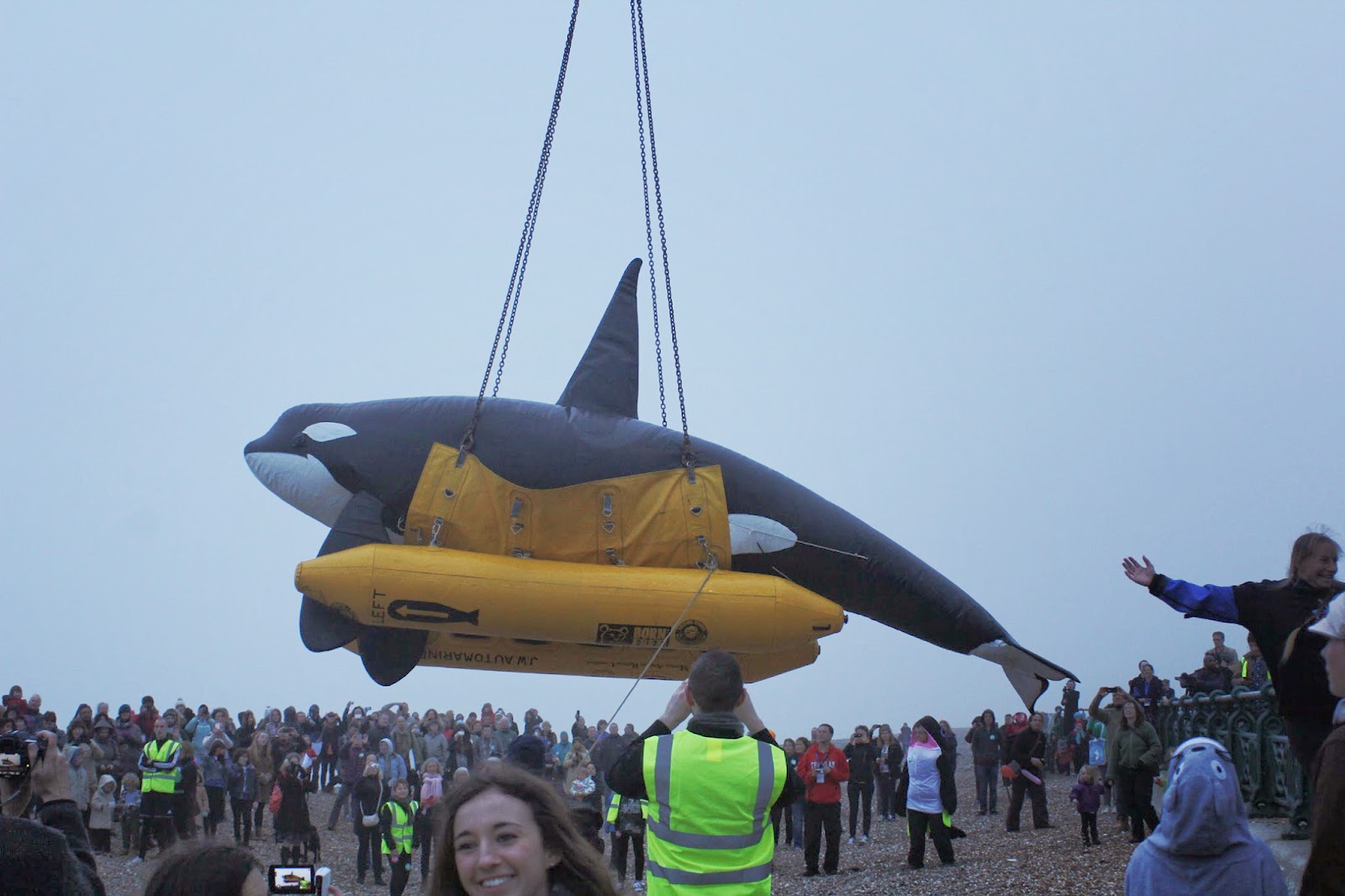
Our Morgan, lifted onto Brighton beach 

So that is what the amazing people at WhaleFest did. They got a life sized Orca, named Morgan, and they drove her to the promenade in a real rescue stretcher. There she was hoisted up and over the railings onto the pebble beach using a real crane. From there, amongst the crowds of people, she was carried down the beach and into the water. Rescue boats from British Divers Marine Life Rescue (the charity which actually does rescue stranded whales and dolphins from around the British coast) came and escorted her offshore. Through the mist of a foggy evening our Morgan was set free, to the tumultuous shouts and applause of the watching crowd.


Followed by crowds Morgan is carried down the beach to the sea


Once on the water she is taken over to waiting rescue boats
by non other than World Renowned Orca Researcher Ingrid Visser


BDMLR boats lead Morgan away into the fog and to her freedom

Of course our Morgan was brought back ashore – we are certainly not ones to pollute our ocean with rubber and plastic no matter what shape it takes – but the message was there, clear and simple. Free Morgan.

Find out more about the fight to Free Morgan at the Free Morgan Foundation website and find out more about the World Cetacean Alliance and the work they are doing here. 

Monday, 28 October 2013

The Hunt

The RIB sped out of Victoria Harbour, skimming over the silky smooth water of the San Juan Straight. Mist, through which the sun was valiantly trying to break through, obscured the Olympic Mountains of the USA and gave a silvery quality to the ocean between. On board a small group of passengers are safely ensconced in large red survival suits. abruptly the boat does a u-turn, and speeds back towards the harbour. Ahead one or two larger boats filled with people are almost stationary, a sure sign of something being about. The RIB slows, approaching carefully. Out of the silvery grey water a tall, black fin rises, a grey saddle just behind this dorsal fin and the hint of white around the eye, as the unmistakable sleek, black body of a killer whale slices effortlessly through the water.

A Bigg's transient killer whale cruises the Victoria coastline

The boat slows almost to a stop, watching at a distance as the killer whales move steadily along the shoreline. There are five, including a large male and a small calf. But these are different to those seen from the kayak. They may be subtle differences but these whales may as well be a completely different species. They are Bigg’s transient killer whales, and rather than feeding on fish as the resident whales do, they feed on mammals. Seals, dolphins, porpoises, are all on their menu. Named after Michael Bigg, who first pioneered the photo-identification of killer whales here and led the way in establishing the different types of killer whales that live off the coast of British Columbia and Washington. Bigg’s killer whales do not vocalise or echolocate as much as resident’s and that is because marine mammals can hear very well underwater. Using stealth they follow the coastline in search of prey and that is exactly what this group was doing. At times they are in water so shallow the tip of the males dorsal fin is still clear above the water.

The group’s progress up the coast slows, they seem to be stalling and then the reason why becomes apparent. A harbour seal, sat on top of a bed of kelp, dinner. The group slowly circle, spy hopping, raising their whole head above the water and taking a good look around and at the seal. Tighter and tighter the five killer whales, including the young calf, circle closer. There is thought to this process. They don’t just go barging in, they work it, thinking, almost assessing the situation, working the best way to get the seal from the kelp. The approach needs to be right, move too soon and the seal could get away. 

Searching, establishing where the seal is

Suddenly there is a splash, the seal’s hind flippers flick up into the air and it is pulled down beneath the kelp. The killer whales surface once more altogether, almost turning in on one small point between them and then it is quiet.

Having pulled the seal under, the group surfaces tight together

Five minutes later the group surfaces again, once more in searching mode as they move off along the coast again…

The passengers sit, stunned. While it is sad to know that seal has been munched, it is the most fascinating piece of behaviour I have ever witnessed. I feel privileged to have observed this part of this killer whale family’s lives. This is nature, this is survival, this is the wild beautiful natural world we live in, and what we must protect.

Friday, 13 September 2013

Orca in the mist...

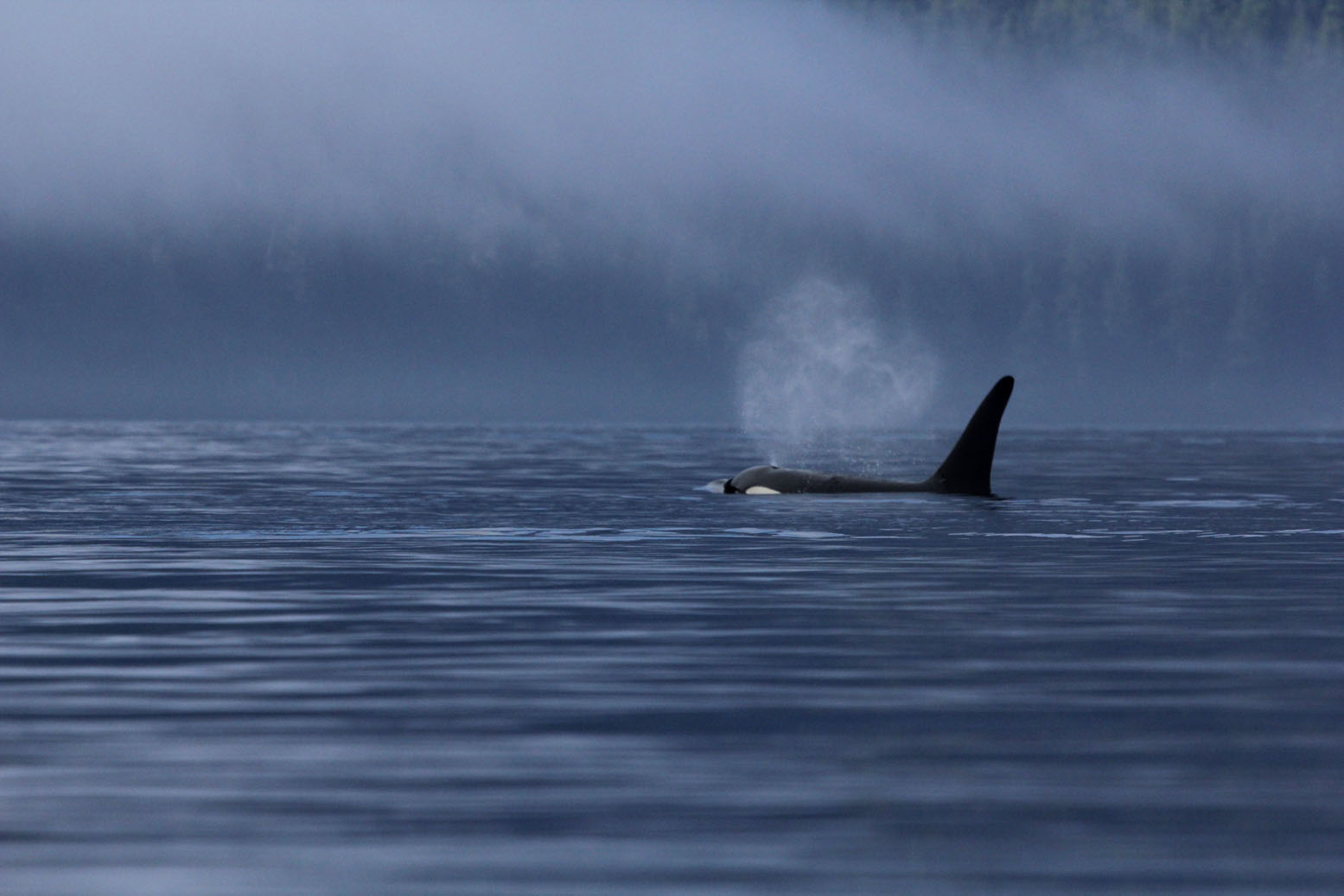
I am sitting in a kayak, the smooth silky water a finger tip away, behind me a huge grey boulder of the shoreline towers above. Pot marked with yellowish, reddish and orangey brown lichen, with brown bull kelp tickling the rock where it plunges into the water, continuing to the depths covered in urchins and anemones. Above and the deep green trees are shrouded by fog. Ahead the fog crowds in close, sea and sky merge, in the near distance a motor boat chugs. We wait. Patient. Well mostly. The handheld radio crackles, voices break the anticipated silence, cutting across the foggy air. Orca are coming our way. The motor boat gets a little louder, the whale watch boat, they must be close. Then hidden by the mist we hear a ‘kawoof’ followed by another and another. The unmistakable sound of Orca’s breathing! In front the steady stream of breaths passes by, unseen, but distinct… 

Minutes pass and all we hear is breathing Orca and the motor boat slowly passing us by. Then, to our right a tall, black dorsal fin looms and out of the mist a small group passes closer to shore, and closer to us.

The main group disappears, their blows getting fainter and with them the motor boat fades away. We are left alone. Four kayaks, five people and four Orca milling around… heaven! 

Here's looking at you!

Our guide drops down a hydrophone, an underwater microphone, and replacing the sound of the engine and the crackle of the radio, the wonderful calls of Orca’s echo through the air.

The mist begins to lift, bright sunlight beams through the breaks, glistening off the Orca’s backs and creating sparkles in the droplets of their breath. The world of Johnstone Strait, Vancouver Island, Canada, reveals itself, a backdrop of forested mountains, rippling calm waters and Orca surfacing in the deep blue-green sea.

Orca in the mist


This wonderful encounter was part of a kayak tour with Kingfisher Wilderness Adventures (http://www.kingfisher-adventures.com/), more adventures from this trip to follow.... Watch this space!