Showing posts with label cuckoo. Show all posts

Wednesday, 27 April 2016

Stanley

On 31st May 2014, on a very misty, very early morning, I caught my first adult cuckoo. He was a stunning bird, and as well as having a metal ring with a unique number this cuckoo was also fitted with a satellite transmitter as part of a BTO project. I wrote a story about that morning called To Catch a Cuckoo, and at the end of that post I asked where would this cuckoo go, how would he fair during his migration south and hopeful return? The bird was named Stanley by generous sponsors Derek and Maggie Washington. 

The magnificent Stanley

Well, by June 2014 Stanley was off! He was over the English Channel and heading south. It is one of the interesting results the tagging project is showing, male cuckoos in particular do no hang around, and very quickly start heading south. By August he was across the Sahara and recovering from the crossing in the dry regions of Nigeria and Cameroon. By September 2014 he had moved further south over the Equator into the rainforest block of Congo and the Democratic Republic of Congo. Here he stayed until starting his northerly migration in January 2015. Heading northwards through West Africa, Stanley arrived in southern Spain in April 2015 and returned to the UK by the end of the month. He was the third of the tagged cuckoos to arrive back, but perhaps a little oddly arrived in Cornwall before heading back to his breeding grounds in Norfolk. Once again Stanley did not stay long, and by mid-June he was in southern France heading south. He arrived in Africa by the middle of July, and by September he was back in the Congo rainforest in the same area where he had spent the previous winter. By March 2016 he was well on his way north and west, and the race with the other tagged cuckoos was on! Who would be first back this time? Early April and Stanley raced over the Sahara and then the Mediterranean, hot on the heels of Vigilamus who was leading the race of the tagged cuckoos. April 21st 2016 and Stanley had won the race! He was the first of the tagged cuckoos to return to the UK in 2016! Whoop! Even more interesting is that once again he first touched down on English soil in the south west! This time Devon. By the 22nd he was back in Norfolk and near to Cranwich!

Such wonderful data is coming back from the satellite tagging, more that we could get from just metal ringing alone. The map on the BTO’s website shows that Stanley tends to head straight down through Italy and across the Sahara on his way south. While on his return he heads northwest into West Africa before heading across the Sahara and back through southern Spain. So far he always seems to make landfall in southwest England before heading northeast to Norfolk.

In the time since I caught Stanley and fitted his metal ring things have changed for me. My life has turned upside down, in a very good way, with the arrival of my little Robyn. But I have continued to catch and ring birds. I have not however held an adult cuckoo in that time.  Stanley, of course is not the only cuckoo to be back in the UK and Norfolk. My first cuckoo of the year was at our ringing site, near to Stanley’s breeding ground, on the 17th April. Then just yesterday, at the next ringing session again a cuckoo could be heard. This time, with the Robyn alarm waking us extra early we took the opportunity to set a net in the hope we might catch another cuckoo. It was not looking great, with the net remaining empty all morning and with a cuckoo tantalising us in the trees nearby. In typical fashion though the last check revealed a rather large looking grey bird in the bottom shelf. For the first time since Stanley almost two years before I had an adult male cuckoo in the hand! While this cuckoo does not have a satellite tag to tell us all the fine details of his movements, he does have a metal ring which if recovered will certainly contribute to the knowledge we are building of these incredible birds. 

The equally stunning cuckoo caught today...


What a bird!
Information on Stanley's journey so far was used with the kind permission of the BTO. 

Wednesday, 4 June 2014

To catch a cuckoo

It was a chilly start to the morning. For the first time in a while the temperature reading was 3° and next to the time of 4 am once again it was a bit of an urgggh moment getting up. This time dense mist hung low, the tops of the trees poking out and reaching into a clear sky above, fading from black through midnight blue to pale blue pink as dawn slowly broke.

Arriving at the grassland heath, bounded by forest and farmland, the dawn chorus was in full swing. Skylarks, garden warblers, yellowhammers, even a turtle dove calling from somewhere in the mist beyond. The occasional tall tree and low grassy humps of what were once, many many years ago, stump rows appear out of the mist like ghost ships. Movement ahead reveals the equally ghostly forms of small sheep, the maintenance team of this grassy heath.

The grass is wet, its tops drooping under the weight of water, as we make our way over to where a tree stands alone. Here a large mesh net is set up surrounding the tree and within the centre a speaker placed. The aim? To catch a cuckoo.

With the speaker on the unmistakable call of a cuckoo booms out through the mist, followed by a bubbling sound that many may not recognise but is the call of a female. We have barely retreated, when the responses start and one then two males start calling in response. A little further away and a real female bubbles also. Out of the mist and over our heads a male makes for the tree and the speaker; perching ceremoniously on the top of our pole! The slim grey body, long tail, white chest with barring and pointed wings resembles a small bird of prey. This is of course on purpose. For cuckoo’s do not worry themselves with rearing their chicks, leaving this for other birds like reed warblers and meadow pipits who in return develop ways of recognising the cuckoo and its eggs. What has developed is an evolutionary arms race. While host birds need to keep a watchful eye for cuckoos, they also need to worry about predators like sparrowhawks that rather than parasitizing their nests are looking for a meal. The cuckoo takes advantage. By looking like a sparrowhawk it causes birds to leave the nest area for that little bit longer, giving the female time (all 10 seconds of it) to lay her egg without being mobbed.

Misty morning... spot the cuckoo

As our percher disappears from the top of the pole, a second bird comes swooping overhead and low in towards the tree, finding its path ultimately stopped by our net which with its large mesh holds onto the bird safely.

Cuckoo in the net

And that my friends is how you catch a cuckoo! (Of course you have to have a ringing licence with a mist net and tape lure endorsement). Up close he is stunning, grey-blue, and perfect barring across a pale chest, bright yellow bill and eye.  And for this guy not only is a unique metal ring added to his leg, a satellite tag is strapped on with a specially designed harness. For cuckoos (and this seems to be a recurring theme for our wildlife) are in decline and we have lost over half of our breeding birds in the last 25 years. But the picture is more complicated than that. In some areas cuckoos are doing better than in other areas, in England for example the decline is greater.

What a beautiful bird!

This is where this satellite tagging project run by the BTO, and championed of course by the BBCs Spring Watch, comes into play. Already the data is showing interesting results with the suggestion of different migration routes and the indication that weather conditions across their range have a significant impact on survival.


Where will this cuckoo go? Which route will it take? How will it fair over the next few weeks, during its migration south, overwinter and hopefully on its return? With its satellite tag will have the answers to all of these questions... soon….

Saturday, 15 June 2013

Meeting a Legend - Sir David Attenborough!

I am sitting on a wooden bench over looking the grassy field and pools of Cranwich. The wind roars through the leaves of the trees and the reeds at the edge of the pools, the sound rising and falling in intensity like a crowd at a football match cheering when their favourite player gets the ball. Overhead, against a sky various shades of grey, swifts swoop and dive. Despite the unsettled weather there is an air of excitement about the site as we wait for a very special guest to arrive. 

Ask anyone who they most admire in the world of Natural History and documentaries, and there is just one name on their lips. Sir David Attenborough. For over 60 years he has been the face and voice of British natural history programmes, giving us some of the most memorable television moments. For me the moment a blue whale surfaced right next to Sir David as he sat in a small boat is one of the most inspiring pieces of footage. The look on his face and the excitement in his voice, mirrors what I feel when I get up close to those magnificent creatures (http://www.bbc.co.uk/programmes/p004t035).

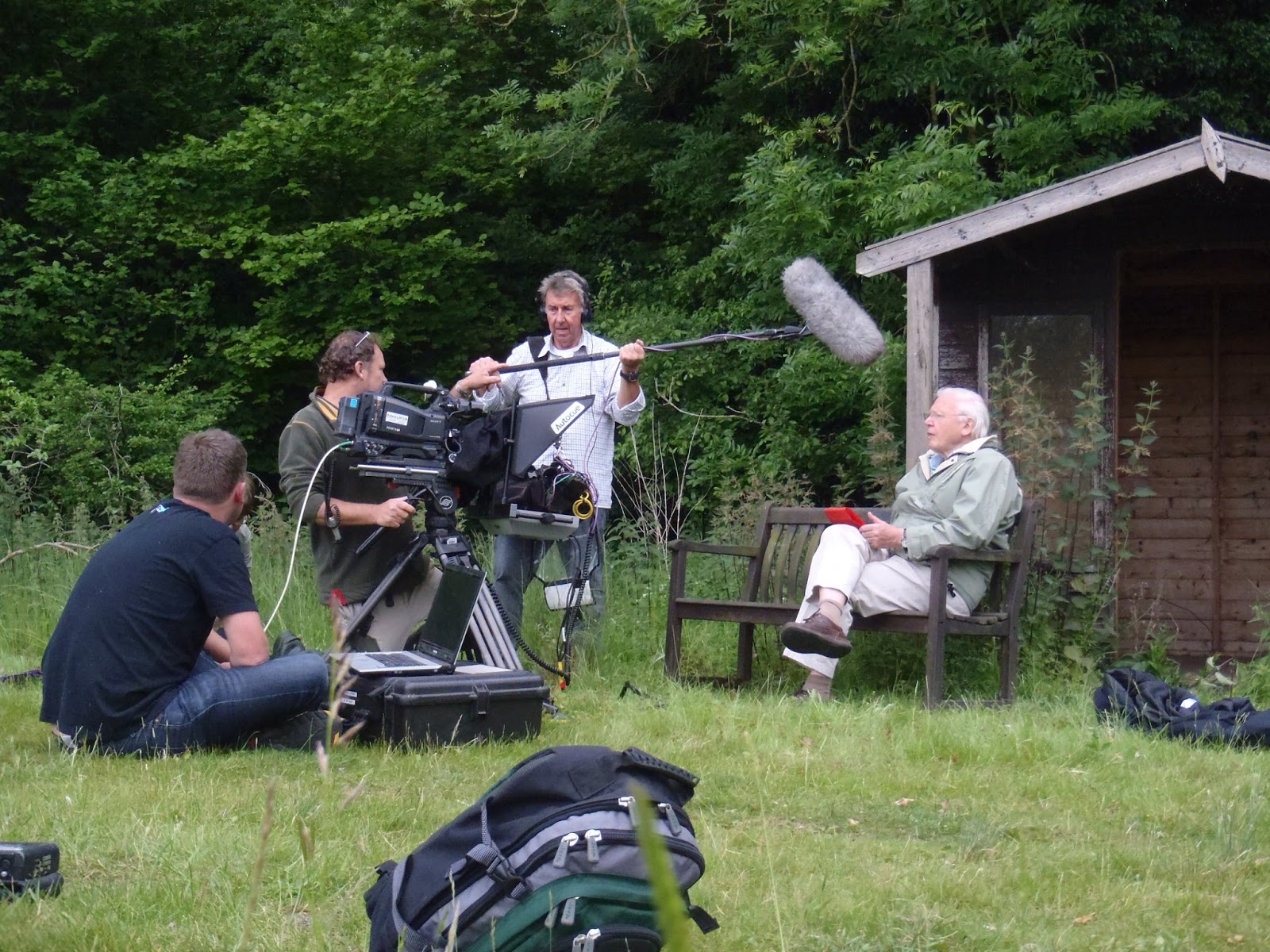
So for him to come to our little patch of reeds in the middle of the Norfolk countryside to do some filming is a dream come true. It was not only the chance to meet him, it was the opportunity to watch him work. 

Having a chat about reed warblers, cuckoos and all sorts (Photo Kate Risely)

The filming for the series Natural Curiosities focused reed warblers and cuckoos, discussing the evoluntionary 'arms race' between the reed warbler host and the cuckoo parasite. From mimicking the egg to mimicking the sound of a whole brood of chicks, the cuckoo aims to trick the reed warbler into raising its offspring for it. The reed warbler responds by guarding the nest mobbing any cuckoo if it gets too close. 

As the morning progressed we watched as David and the team worked, being on hand to offer any advice or help that was required. It was privilege to watch him work, to hear that voice offer explanations for one of natures most curious relationships. 

Sir David at work

and I now have my own most memorable David Attenborough moment, beyond meeting him... 

during one break as we all sat in the long grass keeping out of the reflection in the window of the small hut in front of which they were filming, sitting on the bench where just hours before we had waited in anticipation, David looked at us and said 'you remind me of a pride of lions watching me'

oh to be compared to a pride of lions by the man himself....

Happy Team! (Photo Kate Risely)