Tuesday, 29 April 2014

Fossils on a point

Peace and quiet. The only sounds to be heard is the gentle lap of water on the beach, the twittering of swallows and linnets, the warbling song of willow warbler and skylark, the muted honk of barnacle geese and the raucous calls of gulls soaring in a brilliant blue sky overhead. In either direction coarse sand and pebbles merge into mudflats glinting silvery grey in the bright sunlight. Behind me tall sand dunes with tufty grass and beyond that the soft roar of the ocean.

Spring migration had truly begun at Spurn Point, I had seen my first sand martin, wheatear, redstart and whitethroat of the year on this long spit of land that juts into the river Humber. At one end the distant yellow fields of oil seed rape, dark green mounds of trees with stark white wind turbines that are becoming a feature of our landscape just as electricity pylons did. At the other end a rather battered and bruised lighthouse stands sentry over old abandoned houses and military buildings. A life boat station remains but the families that once called this wild tip of land home have long moved on. Now the men and women working the life boat and the pilots remain on a rotation.

The serenity of Spurn Point

The spit of land is just as battered, the tidal surge just before Christmas destroyed the road that had only just been rebuilt, once again changing the dynamics of this wild landscape. Yet Spurn remains as it always has been a mecca for bird watchers and birds alike. A stop off for migrants, one of the first ports of call for birds exhausted from flying non stop over the turbulent waters of the North Sea and a known hotspot for the more rare and unusual birds that visit our shores. A small piece of quiet and natural solitude, nestled between the industry of the North Sea and the bustle of the cities.

How a landscape can change in a matter of hours. From the bright sunny skies, warm balmy breeze and constant chatter of birds, the morning dawned with a thick blanket of swirling white fog. Tree, bush and building all softened around the edges and kind of more muffled hush descending with only the odd linnet or swallow zooming overhead. And with bird watching looking gloomy Spurn reveals its other secret treasures to me. Fossils. Where cliff and beach have been worn away the remains of ancient wildlife is revealed. With cliffs and sea shrouded in fog, just the rumble of waves crashing and pebbles rolling, we scour those left scattered at the top of the beach searching for that one pebble or stone that reveals its secret so long locked away. And with the fog lifting, we find what we are looking for, ancient creatures carved in stone, preserved for eternity. 

An ammonite and Devil's toe nail (Gryphaea)

Monday, 14 April 2014

Larking Around

Only recently had the trees been felled, leaving a mosaic of sandy soil, mossy grass, patches of dark heather and tangles of twigs and branches. From the main road this seemingly barren landscape sloped up to the tall dark green conifer trees that surrounded the patch on three sides. While it may seem an extreme change this is the cycle of this forest where trees are planted and felled on a rotation. Add to that the process of returning areas to more natural grassland heath and more of such open areas can be found amongst the blocks of trees. For 100 years ago this landscape was totally different. The entire area was open with grass and heather heaths, open sandy areas, low intensity arable farming and abandoned fields. Rabbits in particular were farmed in large enclosed warrens. Following the First World War the Forestry Commission began the process of afforestation, planting hundreds of hectares of Scots and then Corsican pine to provide a reserve of timber for a country whose trees had been as ravaged by the demands of war as its people. Today the whole of Thetford Forest is a patchwork of pine plantations, broadleaved trees and heath land, and is managed not only for timber, but for recreation and wildlife.

Woodlark carrying food for its chicks

Such barren looking patches of clear fell and grassy heath provide important habitat for a number of scarce breeding birds, including the woodlark. The tufts of short grass, close proximity to bare soil and good high posts for singing, are all perfect for woodlarks to set up home during the summer.

Knowing an area is good for breeding woodlark, seeing a pair there with the male’s sweet song of melancholy notes which includes a lu-lu-lu, giving the bird part of its scientific name Lullula arborea, is one thing. Finding its nest is a whole different ball game, one of patience and knowledge. Even knowing there is a nest within a few square feet in front of you, it is still hard to see, such is the excellent cryptic nature of nest and chick.

A beautiful woodlark nest

But there nestled amongst the grassy stems is a tightly weaved nest, in which four greyish brown chicks are squeezed in. What a privilege to be allowed to approach and view such a nest, which is done under strict licence. Monitoring of this species has never been more important. Since the early 1980s the range and population of woodlark in the UK has actually increased following a severe decline, but it is still comparatively rare and its breeding range restricted. Forestry plantations form a key part of this increase, but interestingly in the Forestry areas of Norfolk and Suffolk numbers of woodlark are in decline. Understanding more about the movements, breeding success and habitat use of birds in such areas is contributing to maintaining and increasing woodlark numbers by feeding into management plans for the forest. To that end this, and other nests are being monitored from egg laying to fledging, and the chicks are being colour ringed to look at movements of birds and where they subsequently return to breed.

Feed me!

On returning these four chicks to their snug nest and stepping carefully away to a safe distance, we watch as both parent birds call with a soft ‘tlewee’ to each other, beaks full of recently foraged insects, before swooping in back to the nest. We turn to leave, happy birds, happy chicks, happy people. 


Saturday, 5 April 2014

A Snipe's Tale

Back in May 2011 it was just another ringing session at Cranwich. We had been ringing in the reeds and surrounding land for a couple of years. The project was just starting, who knew where it would take us and where we would be now with it. The huge number of reed warbler nests found and monitored, the vast number of birds ringed from reed warblers and lesser whitethroats to kingfishers and reed buntings. But that was all to come. On this day it was a different bird that caught our eye as we rounded the corner and approached one of the nets. There in the top shelf was a common snipe. Never before had I held a snipe in the hand and never before had one been ringed at Cranwich.

Me and the snipe at Cranwich
With its dark brown, rufous and pale streaks, short legs, stocky body, dark liquid eyes and long straight bill the snipe may not be bright and colourful, but it is nonetheless beautiful. In the UK the snipe is widespread and resident, making short to medium distance movements, breeding particularly on moorland and in grassy upland areas. Lowland areas have seen declines in breeding numbers but see large numbers skulking around the edges of pools in winter. Our snipe was likely to be passing through with none so far recording breeding at the site.

And so we took the usual measurements, and some additional ones of the bill and head, it was good practice for our upcoming first trip to the Gambia, where we would catch more common snipe as well as painted snipe in the trips that followed.

Measuring the bill of the snipe

Fast forward three years (is it really that long!) and a well placed source at the BTO receives a recovery of a snipe, unfortunately shot dead in northern Spain. It is none other than the snipe we ringed all those years ago. It seems that this snipe was not content to remain just in Britain but was making at least one movement within the species wider range. Evidence shows us that while part of the UK breeding population is resident, numbers in winter are bolstered by migrants from the continent and Iceland. In fact throughout the Western Palearctic the species is much more migratory, moving between northerly breeding grounds and more southerly wintering grounds. More than that research indicates there are actually four separate snipe flyways with overlap between.


Snipe flyways from Svazas & Paulauskas 2006
This snipe was shot in the county of Asturias in northern Spain, falling within the North-West Europe flyway (number 2 on the map). Of course this recovery tells us nothing more than this bird was originally ringed in Britain in May 2011 and was then shot in northern Spain in January three years later. It does not tells us where this individual was breeding or where it usually spent its winter. But it does add to the overall all picture that birds are moving between Britain and continental Europe, something we would not have known if it were not for the individual marking of birds. 


Wednesday, 26 March 2014

Virtual Whale Watching

March 15th and 16th 2014, and without even leaving the Hilton Hotel I had guided nearly 10 whale watching trips in the Azores. I had helped passengers into rather fetching bright orange, bulky lifejackets and then climb into our boat. I had given them a chat about not throwing rubbish (or themselves!) overboard, about how we follow whale watching guidelines and how we collect data, turning round and pointing to my science guide, clipboard in their hand. We had then headed off, passing yachts and other boats, heading out past mount Pico. I had told them what to look for in order to help us find whales and dolphins, pointing out that it did not matter whether it turned out to be a whale, a wave or an office chair (it happens to the best of us!) I would rather they shout out. And not before too long we had come across a huge flock of Cory’s shearwaters followed swiftly by a small group of Risso’s dolphin. Heading on and we come across our first sperm whale, the largest of the toothed whales and famed for being Moby Dick. We get even more excited as suddenly a mother and her calf surface just ahead, resting at the surface before they dive, the mother lifting her tail high out of the water. 

Lifejackets, boat and whales!

We continue on, sperm whales can hold their breathes for over an hour so she may be some time, and are suddenly surrounded by a huge mixed group of bottlenose and common dolphins. The common dolphins come so close you can see them under water and hear them whistling. As quickly as they arrived the dolphins are gone and our search continues. As we travel I reach over and scoop a plastic bag from over the side, highlighting the issues of plastic in our oceans and the problems it causes when eaten by whales, dolphins and turtles. Then there ahead, another sperm whale, a big male this time. He is huge. We watch as he breathes at the surface, you can feel the spray from his blow on your cheek, before he too lifts his massive tail into the air and dives. Camera’s click madly as out science guide gets a picture for photo ID. 

A sperm whale dives beneath the waves

It’s not over though as we now come across a nursery group of young sperm whales. Time for the hydrophone. With one passenger clasping the end of the rope we lower the underwater microphone over the side and listen carefully. Regular clicks can then be heard, sperm whales echolocating beneath us, searching for their prey. Before too long it is time to leave, the last whale lifts it tail and dives beneath the waves, we haul in the hydrophone and head for home. But never say never, as we speed a long one final dolphin leaps out from infront of us. 

One final leap of a dolphin!

And then there is land, and more boats and the harbour again. We are back. I thank them for coming, for yelling loudly everytime they saw a whale, and for listening. I tell them to go and ask whale watch operators whether they follow guidelines, pick up litter, collect data, and encourage them to go whale watching responsibly. 

This is virtual whale watching WhaleFest style. The boats are real, the lifejackets are real, the whales are real, well on the screen they are. Real water is sprayed at the kids when the whale surfaces, eliciting shouts of surprise and delight. The clicks and whistles are real recordings. You can really feel the wind in your hair as a fan surreptitiously whirls from the side of the screen. And the screen! A huge, curved horseshoe shaped behemoth of a screen that really does make you feel like you are there. 

That was my WhaleFest 2014. Now perhaps I should actually go to the Azores…..

Wednesday, 19 March 2014

Sweet Release

When I first heard about the Orca Morgan’s story I was angry. Angry at those who had stolen her chance of finding her family and stolen her life. It’s not the fact that she was taken from the wild, she was alone and starving when found, it’s natural to want to help. That I understand. What I am angry about is that once in human care she was put on display against the conditions of her permit, fed dead instead of live fish and ultimately, despite all the evidence and a viable release programme, sent to live the rest of her days in a concrete tank in Tenerife where she is bullied and abused by the other whales and it seems her keepers.

The fight to free Morgan continues, the verdict from the latest court hearing is due sometime in April (they keep delaying for some reason…) and all the while people keep protesting, raising awareness not only of Morgan’s story but also of the plight of all other captive cetaceans. The battle against SeaWorld and all other dolphinariums is well and truly underway.

The issue of whales and dolphins being kept in captivity and particularly Morgan is just one of the campaigns the World Cetacean Alliance is running. The Long Swim to Freedom campaign features the issue to free Morgan AND to save the last 50 Maui’s dolphins – New Zealand’s critically endangered endemic dolphin. And what better way to raise awareness and support for this campaign then at WhaleFest 2014 the world’s biggest celebration of wild whales and dolphins. But how to make an impact beyond those who tread the halls of WhaleFest? How to send a message to the world beyond?

Well, why do what we are all dreaming of and release an Orca?

Sounds impossible right? Well for Morgan, and the many other Orca in captivity there are very real options for this! But aside from that, for a group of willing volunteers no matter how much they may want to, releasing a real Orca into the sea off Brighton may be pushing it. But who says it has to be real to make an impact? 


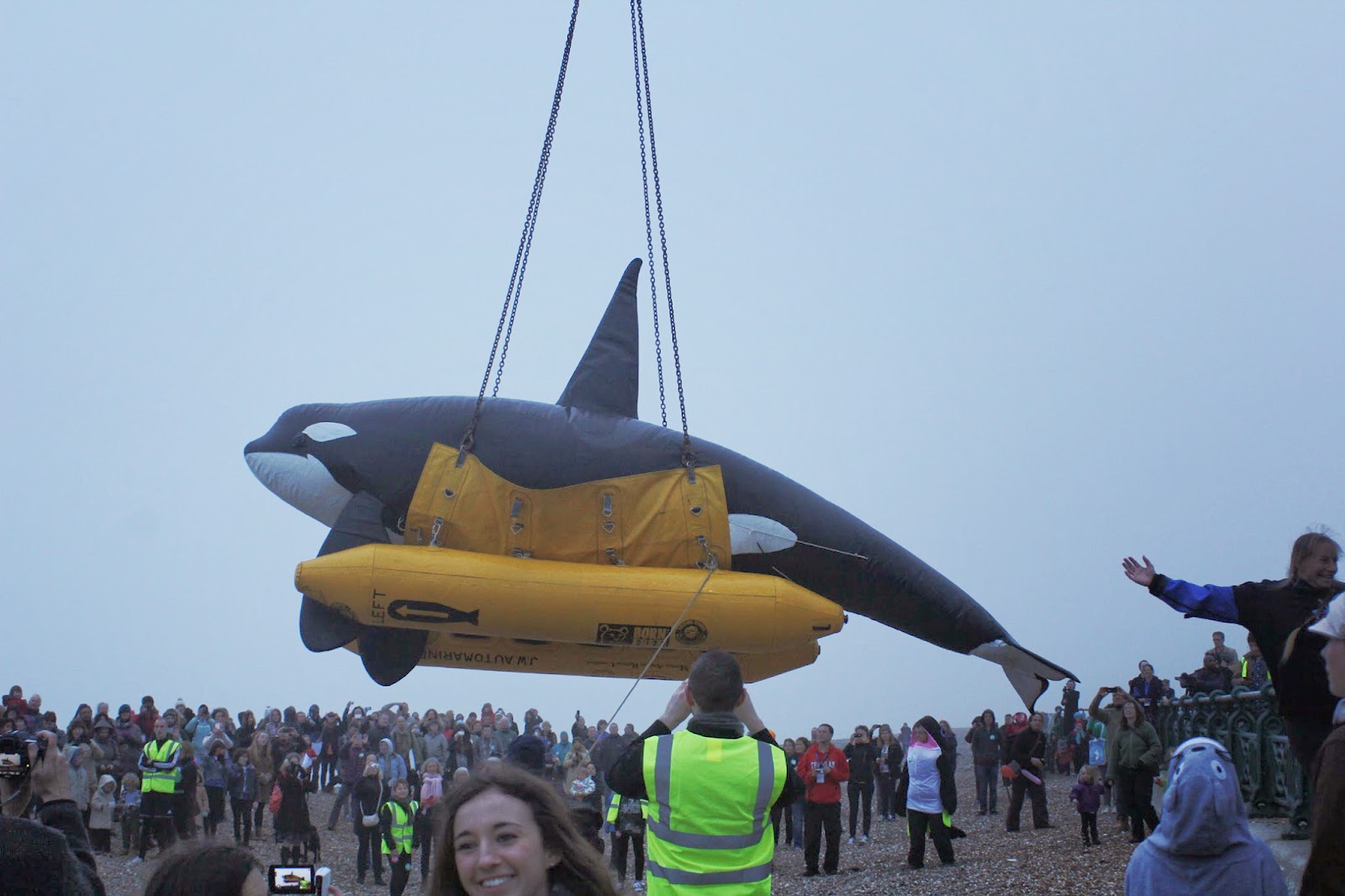
Our Morgan, lifted onto Brighton beach 

So that is what the amazing people at WhaleFest did. They got a life sized Orca, named Morgan, and they drove her to the promenade in a real rescue stretcher. There she was hoisted up and over the railings onto the pebble beach using a real crane. From there, amongst the crowds of people, she was carried down the beach and into the water. Rescue boats from British Divers Marine Life Rescue (the charity which actually does rescue stranded whales and dolphins from around the British coast) came and escorted her offshore. Through the mist of a foggy evening our Morgan was set free, to the tumultuous shouts and applause of the watching crowd.


Followed by crowds Morgan is carried down the beach to the sea


Once on the water she is taken over to waiting rescue boats
by non other than World Renowned Orca Researcher Ingrid Visser


BDMLR boats lead Morgan away into the fog and to her freedom

Of course our Morgan was brought back ashore – we are certainly not ones to pollute our ocean with rubber and plastic no matter what shape it takes – but the message was there, clear and simple. Free Morgan.

Find out more about the fight to Free Morgan at the Free Morgan Foundation website and find out more about the World Cetacean Alliance and the work they are doing here. 

Saturday, 8 March 2014

In a pear tree...?

A hooked blood red bill, red rims circling a beady black eye. A broad black line runs through the eye down and round a creamy white bib. Startling black streaks line the neck merging into a grey belly that switches to a soft brown underneath. Russet brown, black and white stripes stand out brilliantly on the flanks. The back is that soft brown while the top of the tail returns to grey. A small, dumpy bird that sits on bright red scaly legs and flies with rapid stiff wings when spooked….

Such a strange exotic looking bird but rather than sitting in a pear tree these guys are usually found running through open fields in small groups. It is the red-legged partridge...

Red-legged Partridge

Not a native species to Britain, but an introduced species from continental Europe where it is mainly found in France and Spain. These days as well as the wild population an estimated 6 million red-legged partridge are released each year for shooting.

Aside from being a non-native species whose numbers are artificially inflated there is another reason why red-legged partridge are not ringed. Under the British and Irish Ringing Scheme in the majority of cases the metal ring is placed on a bird’s tarsus. There are very few exceptions (usually waders) where the metal ring or colour rings are placed on the tibia. Under other ringing schemes they do ring on the tibia as my lovely Mediterranean gull is demonstrating...

Foreign ringed Mediterranean Gull with rings on tibia and tarsus

The red-legged partridge has however a spur (big bump) on its tarsus. So when one blundered into my net, leaving a neat partridge shaped hole (oops!), I couldn’t ring it but I could marvel at this rather striking bird.

Red-legged Partridge highlighting the spur on its tarsus

Saturday, 15 February 2014

Its not just about wildlife

Ringing expeditions are not just an opportunity to see, handle and learn about new species of birds. They are an opportunity to meet new people, to learn about new cultures and immerse yourself in the local landscape and community. And in many cases it is an opportunity to give something back. In The Gambia, the Kartong Bird Observatory not only aims to study bird populations and migration but to raise community awareness and understanding of the environment and the economic benefits of biodiversity conservation.

Through strong community links the observatory team sponsors local students and a football team. Each year three or four lads help with the ringing course, carrying kit, helping to cut net lines and setting nets. At the same time the boys are taught about ringing, birds and conservation.

Teaching Ernest and Alieu about birds and bird ringing

For me nothing means getting involved with the local community than visiting the school. Each time I have visited Kartong as part of the ringing team, I have taken time out to go and visit the local school, and nothing beats it. The first year I visited we were surrounded by smiling faces in the playground.  

Surrounded by smiling faces (well mostly!) at the school (Photo: Laura Blackburn)

This year they were all in class, one of which we were invited to sit in on. What a memory, 20 or so little people all clamouring for us to sit next to them, then singing, clapping and dancing their way through the alphabet. It was a privilege and honour to join in watching their little eager faces as they worked their way through a song associated with each letter.

Singing in class!

I left that classroom feeling elated, what an incredible experience and something I will remember just as much as ringing a vulture, pied kingfisher or any other bird.