Sunday, 17 March 2013

The first of the year

After ten days bouncing around the frothy blue waters of the Caribbean in sublime heat, it was more than a bit of a shock to the system to return to the icy cold of Norfolk. Hail storms, remnants of snow and it felt like winter's grip had not lessened in the time I had been away. Yet, there were signs that spring was at least on its way. Blackbirds, song thrush and dunnocks were all in full song. More and more patches of snow drops were unfurling their delicate petals, clustering together in splashes of brilliant white. Daffodils sprung up along the borders, adding yellow to the palette. After months of dull greens and browns, they bring a welcome breath of colour and hint of spring. 

The beauty of snow drops

The paths around Thetford, through its historic castle mound and along the swollen rivers, remained muddy. Barley's paws and tummy were splattered as we made our way along the trails. Passing a piece of ivy hanging over a crumbling wall, a robin flitted down and out. Its tail flicking. Something about this birds behaviour piqued my interest, the nester in me, having been in hibernation, stirred. I ducked under and there in my line of sight was a neatly woven nest tucked amongst the branches gripping the wall. 

The beautiful robin

The season had started, here was my first nest of the year. Three warm eggs, waiting for a couple more. A visit a few days later reveals four warm eggs. For the next few weeks the progress of this individual nest will be monitored. The eggs, chicks and outcome recorded. Although one nest, it is hopefully the first of many I might find this year, and its record will be added to a national database, from which any number of questions can be answered. 

The nest with its four eggs

Monday, 18 February 2013

An Otter Day


Finally a day dawned bright and sunny. Clear blue sky, interrupted by only the occasional whisp of white cloud, arched above the river meandering its way through shady woods. Despite the thin layer of frost covering the ground this morning, it felt like spring was well on its way. Birds sang out through the clear air, hidden amongst the branches and evergreens of the wood. A muntjac stag, with small but prominent antlers, stood firm but wary in the undergrowth watching the dog and her owners pass by on the muddy path. The swollen, murky brown river swept past, its smooth surface undisturbed until reaching a turn in its path where it swirled in small eddies.

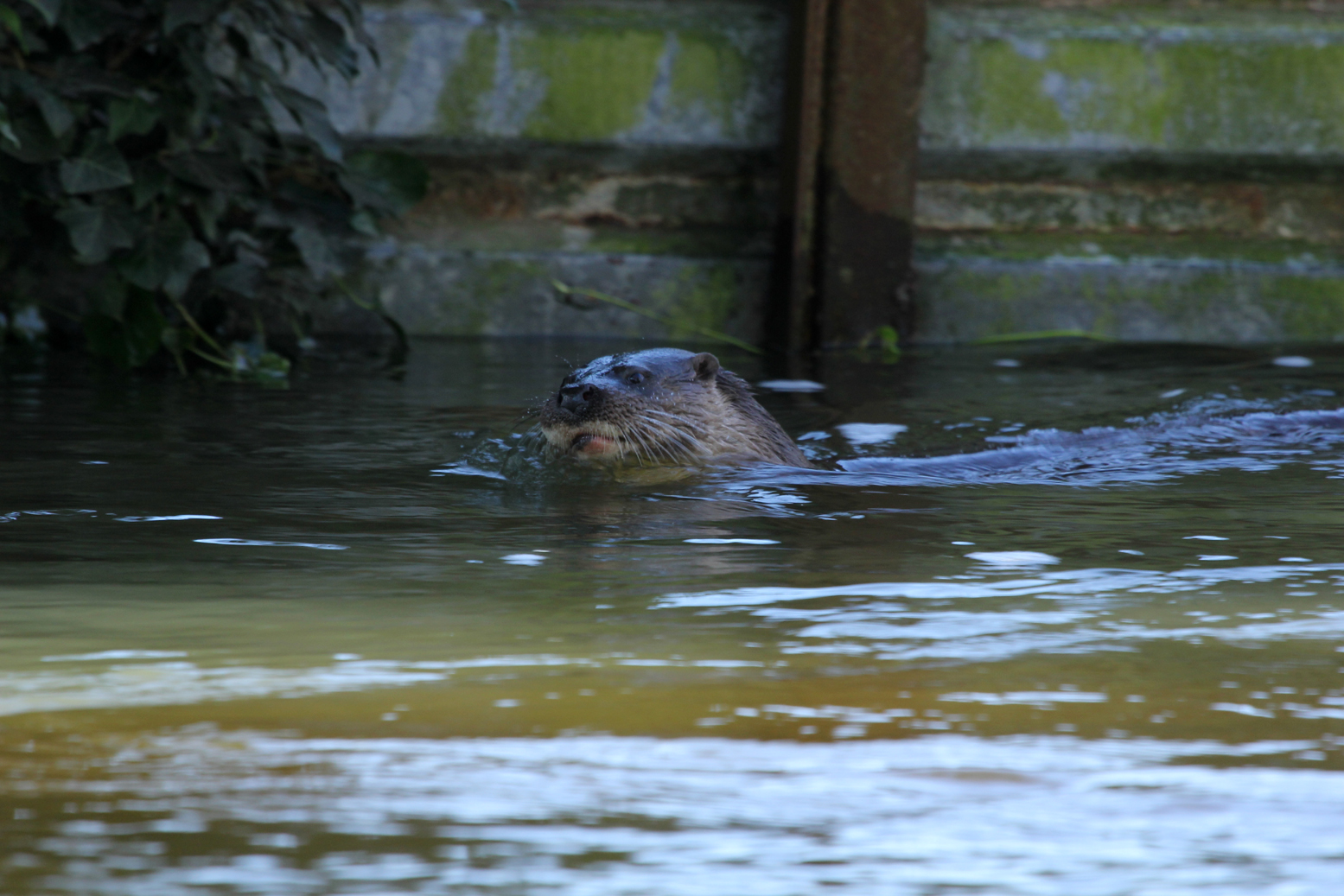
Ahead a sleek, brown body rolled, breaking the calm surface of the river. Following a trail of bubbles and the mystery resident surfaces again, an otter. Working his way along the far side, the otter repeatedly dived, surfaced and dived again. Often he would appear chomping on some morsel of food, occasionally he would stop for a rest before continuing along his mission up the river. 


Munching on a morsel of food


Following a dramatic decline in numbers between the 1950s and mid-70s, legal protection, cleaner rivers and management has led to a resurgence in the UK otter population, with otters now returned to every county in England. Although many may not agree to me it is a welcome return, a true conservation success story. 

In the rivers, streams and estuaries of England otters are usually elusive and secretive, coming out to hunt between dusk and dawn, and shying away from human activity. Many however, are becoming more active during the day reflecting their increasing distribution but also with less persecution these wild animals may becoming less wary of people. Along the rivers and lakes of Thetford the otter has become somewhat of a local celebrity, often being seen hunting and playing in broad daylight. In the past few years a female, her cubs as well as a male or dog otter have all been encountered along a stretch of river that runs right through the center of town. 


The otter and his mustache!

Today's encounter was with a dog otter with a rather distinctive muzzle, the pale fur above the upper lip and beneath the nose making it look like he has a mustache! Along the rivers edge, dappled with sunlight, he continued to work his way up river before finally, having had his fill, disappearing into the undergrowth of the bank. 


On his way again...

Wednesday, 13 February 2013

Rubbish Ringing


The huge mound rose out of the hole in the Earth, a mountain not of rock or soil, but of rubbish. A huge compactor with spikes in the wheels and a massive bucket on the front beeped and revved as it moved piles of waste around the plateau at the top of the tip. Above hundreds upon hundreds of gulls circled, a swirling mass of grey and white, calling and screaming, peppered with the black shadows of crows and small flocks of starlings.

Dwarfed by the compactor and the other trucks on the tip, a white Landrover and trailer bounced and slid its way to a corner of the tip face and near to the sloping edge of the mound. On opening the door a sweet, sickly smell of rotten food and rubbish assaults the senses, but surprisingly you soon become immune only occasionally getting a strong whiff as the morning progresses.


The gulls and the tip

Amongst the piles of rubbish, seven intrepid ringers set a net. Not a fine mist net strung up between two poles, but a net lying on the ground and attached to rods which protrude from canons. Yes canons. On firing the canons fire the rods out taking the net with them, up and over the birds beneath.

With the net ready, we retreat and the compactor pushes over a load of fresh rubbish, laying it in front of the net. All there is left to do is wait, wait for the gulls to settle and feed, wait for the right time to fire the net, wait for the right kind of rubbish to come, and all the while trying not to think about what exactly it is your standing on. A continual stream of trucks brings fresh rubbish to the tip face, dumping their contents before the tractor and compactor spread it around. The minutes tick by, it gets colder, our feet and fingers go numb. With a fresh load spread out in front of us, finally there is interest. A moment later and a muted boom echoes out, the net had been fired. In an instance we go from waiting to action, scrambling up and over the piles of rubbish, towards the net beneath which are a hundred or so gulls.

With the gulls removed from under the net and placed into Hessian sacks, we could settle down (as settled as one can be on a rubbish tip) to process the catch.

First off a treat - a yellow-legged gull. Like lesser black-backed gulls and true to their name, yellow legged gulls have well yellow legs. In adults the back is a shade lighter than a lesser black-back and a shade darker than a herring gull. Capiche? There are of course other more subtle differences…


Adult yellow legged gull

Next there were 99 black-headed gulls, each one ringed with a uniquely numbered metal ring and a bright red and white colour ring. Small and dainty, black-headed gulls are easy to handle, and since they attain adult plumage after one breeding season they are relatively easy to age.

Then there were 70 lesser black-backed gulls. Bigger, meaner, with a bill that’ll draw blood if your not careful, and even if you are! Aging in larger gulls gets more tricky as they will go through four juvenile plumages before they reach the full adult plumage that we all recognise. Most, if not all the birds today were adults, with only one or two retaining the odd juvenile type feather. Again each one was ringed with a metal and a colour ring. Recapturing gulls is unusual, so in order to increase the sightings rate of these birds colour rings are added which can be read in the field without having to catch the bird again.
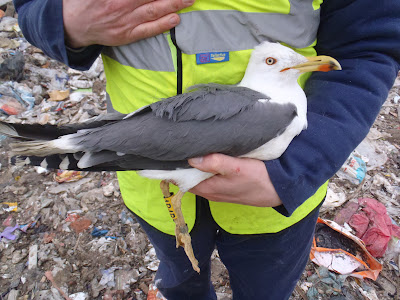
Lesser black-backed gull
After the lesser black-backed gulls we moved onto 19 herring gulls, this time with more juvenile birds and a range of ages, providing an excellent opportunity to see how the plumage varies.

The last bird of the day was a beast, they are not called great black-backed gull for no good reason. Not only are they larger overall and their back blacker, their bill is monstrous. With this bird you can’t even give it a chance to bite, do so and it may well snap a finger. Still never one to dodge a challenge, here I was with this adult bird lain across my lap, head safely tucked away beneath my arm, wrestling to put one of larger and harder rings in the BTO ringing scheme on its leg.


Me and the beast that is the great black-backed gull

So why, why stand in the cold on a smelly tip in the middle of February? Why run the risk of injury handling such big, mean birds? Landfill site may be stinky horrid places for us, where we hide our wastefulness underground, but for gulls they are the perfect place to feed and loaf during the winter. And they do so in vast numbers, providing the perfect opportunity to catch them in large numbers. By catching and colour ringing these birds we can find out where they move during the winter, where they breed and how this may vary between different species, ages and populations. It may surprise you but many of our large gull species are declining, and ringing is just one tool to help establish why.

One bird in particular during today’s catch highlighted this perfectly, a black-headed gull with a Lithuanian ring on. Hatched last year and in all likelihood ringed as chick in the breeding colony. Now here it was feeding on an English rubbish tip.

As they say… It’s a dirty job but someone’s got to do it….


Black-headed gull with a Lithuanian ring on,
we then added the colour ring

Monday, 28 January 2013

A Special Winter Visitor


Despite a fresh layer overnight, the snow of Saturday morning was soft and slushy. Great slabs of it slid off the greenhouses and polytunnels of the farm. The steady drip of snow melt came from roofs, leaves and branches, beneath which the snow was pockmarked with tiny holes where drops of water had fallen Golden light from the morning sun filtered through the surrounding trees, catching the droplets and sending millions of miniature rainbows dancing over the remaining snow cover. Still the snow continued to crunch underfoot, still the poles froze your fingers and still the ice still clung to the edges of the pond.

The woodland surrounding the farm glittering in the snow and morning sun

Birds still flocked to the farm’s garden, twittering from the tops of the trees before dropping down, not so much to the small gap of free flowing water in the pond but to the feeders full of sunflower and Niger seed. The thaw was unlocking water in the wider countryside but food remained hidden, and so the birds came. Flocks of brambling gathered to feed on the seed scattered below the feeders, a charm of goldfinch flew in to nibble at the Niger seed dangling above. The usual accompaniment of great, blue and coal tits grappled with sunflower seeds or pecked at peanuts, often hanging upside down from the feeders. The odd lesser redpoll and siskin joined in the foray, while a group of long-tailed tits buzzed from bush to tree to feeder, their excited trilling calls giving their location away.

Blue tit feeding on peanuts

Briefly intercepting the bird’s busy comings and goings was the gardens usual compliment of mist nets and traps. For the ringers the morning was equally as busy, and one species in particular stole this snowy morning’s show - the brambling.

Each winter we ring a fair number of these stunning finches, before they head back north to breed in Scandinavia. We've even had a recovery of a bird ringed at the farm and then caught again in Norway. But as yet the bramblings we have recaptured at the farm have been ringed in the local Thetford area. That is until today when a brambling turned up in the walk in trap with a ring on that looked a little different. It looked different because it was a Norwegian ring!

The Norwegian ringed brambling ã  Claire Thacker 

This young male, hatched last year, had left the icy grip of the Norwegian winter and made it across the North Sea to the UK. Here bramblings make the most of our milder winters, feeding in particular on beech mast. When freezing conditions like those in the last couple of weeks grip the UK many head into gardens in search of water and food. In a couple of months this and most of other thousands of brambling wintering in the UK will return to Scandinavia to breed. Exactly where this bird will head to for its first breeding attempt is unknown, most brambling lack any strong fidelity to particular sites moving between breeding locations…so far as we know. With a ring on we have a better chance of building up an accurate picture of this brambling’s habitat and nesting choices and its movements; we just have to hope it gets caught again…

Sunday, 20 January 2013

Trap Happy


Winter’s icy embrace grips the country. Snow falls from leaden skies, softening the harsh lines of the landscape and turning it into a glittering wonderland (as long as you don’t have to travel anywhere). With plummeting temperatures the world freezes and any standing water becomes locked away and treacherous underfoot. For birds such frozen conditions present a serious challenge. With food covered in deep snow and fresh water frozen solid, many flock to gardens where both may be in more plentiful supply. Feeders full of energy rich seeds, fat balls, apples, fresh unfrozen water, all draw in regular garden birds but also more unusual species struggling to find food in the wider countryside. Brambling, redpolls, redwings, fieldfare and even waxwings are just a few of the more unusual species of birds encountered in gardens at this time of year.

Bramblings flock to food provided in feeders

The close proximity of such birds relying on garden provisions is just too good an opportunity for a ringer to miss. However mist nets are not always the best way to go. Against the brilliant white of the snow, the black netting becomes more visible. In these situations walk in and drop traps provide an excellent additional method of capturing those birds that are willing feed on the ground, including some finches, and thrushes. Taking pride of place amongst the flower and vegetables beds of the Barber garden is one such trap.

Sunday morning and one of those unusual species of birds entered our garden. A fieldfare! From the top of the tree it warily eyed the scattering of seed and apples, weighing up the desire for food against the rather odd looking trap. Eventually seeing no imminent danger, the bird dropped to the ground and carefully wandered in. Within seconds the trap had been released and the bird was caught!

The stunning fieldfare

Its not every day you get to ring a fieldfare. Occurring in Britain during the winter, fieldfares are predominantly found in open woodland, arable farmland and in hedgerows. Habitats that are difficult to catch birds in at the best of times.

With a brand new shiny ring on its leg this particular fieldfare was soon back to old ways, nibbling on the apples next to the trap in the garden. Come the spring it will be heading back to Scandinavia to breed, and hopefully at some point may be caught again whether it be on its breeding territory or perhaps back in the UK next winter, nibbling on the Barber’s apples.


Tuesday, 15 January 2013

Dipper Dipping


There are many levels to the world of bird watching, from casual bird watchers who just enjoy watching birds on a stroll or the occasional trip to a nature reserve, to the more serious birders, those who spend most of their free time watching birds, searching areas and keeping records of what they see. Thrown into this mix is twitching. A British term, twitching means the pursuit of a previously-located rare bird. Of course its not black and white, you are not necessarily just a birder or a twitcher, but in many cases when you start twitching you tend to get caught up in it, travelling hundreds of miles to see one rare bird and add it to your list.

As with many hobbies, twitching tends to have its own vocabulary; terms that mean one thing to the general Joe Bloggs may mean something entirely different to the twitching fraternity. One such term is to dip. This means you miss seeing a bird that you went looking for.

Personally I have done the odd bit of twitching over the last few years, although I have always gone for birds within my local area. The lure of seeing a rare bird on your home turf is often just too good an opportunity to miss.

Out birdwatching - in these kind of conditions its easy to dip a bird!

Just prior to Christmas a bird turned up in Thetford that I was intrigued to see, and would twitch given that it was spotted less than five minutes from my house! The bird was a Black-bellied Dipper. Now we get Dippers in the UK, predominantly in the west and north of the country. Head to many fast flowing rivers in Scotland and Wales, or upland areas of northern England or even south west England, and you may just encounter this fantastic little bird that will hold itself under water in order to feed. These birds are however a subspecies with the scientific name Cinclus cinclus gularis. The nominate subspecies, i.e. the originally described population is known as Cinclus cinclus cinclus, or the Black-bellied Dipper. This subspecies breeds throughout northern Europe, migrating to milder regions during the winter, including occasionally to Britain. Physically the differences may seem quite subtle, Black-bellied Dippers have no chestnut on the lower breast unlike our resident Dippers. When a Dipper turns up in eastern Britain in winter its worth taking a closer look as more often then not it is a visitor from the continent.

One of our British breeding Dipper - note the chestnut band on the breast

Although technically the same species as those Dippers I had seen in the past, I was still interested in seeing this bird, and so on a number of occasions I headed down to the river, with Barley in search of the bird which by now had generated quite a bit of attention on twitching and birding websites. And each time we dipped. While the reports kept coming in of the bird being seen, each time we went it was no where in sight.

The first weekend into the new year and whilst on a general walk with friends along the river we spied a huddle of people, all wearing binoculars, some carrying telescopes and more than a few pointing very long lensed cameras at the same bit of river; the unmistakable sign that an unusual bird was about. It had to be the Dipper. Approaching carefully and quietly along the muddy bank, there perched up on top of a log for all the world to see was the Black-bellied Dipper. So many times I’d dipped it and now there it was, on full view, characteristically bobbing up and down and seemingly oblivious to the clicking cameras and quiet murmurs of the spectators.  

The Thetford Black-bellied Dipper ã Lee Barber  

Monday, 24 December 2012

Colourful Coot


The coot, a small black water bird with a white bill and shield on their forehead. A numerous bird, occupying seemingly every pond, lake, puddle or river in Britain. You only have to go to one of these bodies of water during the winter and the place can be teeming with them. Bobbing their heads back and forth, quarrelling with one another, and readily coming to areas where families feed the ducks. But return to the same place during the summer and there maybe only one or two present. Nesting for sure, pairing off onto territories and raising one or two broods. But where do all those birds that frequent large bodies of water during the winter go to breed? For a bird that is so common, we know little about their movements not only between summer and winter, but also their winter movements. Do they stay in the same place all, or do they move around?

Once again ringing is helping to answer some of these questions. In the hopes of increasing the reporting rate of the coots they ring, an intrepid group of ringers in the Lancashire area started adding colour rings.

Colour ringed coot

Catching coot is not as simple as putting a mist net up and hoping one bundle’s in. In most cases ringers use a variety of traps where the birds walk in, lured by a source of food a trigger a door mechanism. This group of ringers however have come up with a much more novel way, taking advantage of large groups of coot coming to public areas where ducks and geese are fed, especially during winter when food in the wider environment is not as readily available. Making the most of these feeding frenzies and the distracted birds, these guys simply reach down a grab a coot from the water!

In 2010 one of those colour ringed coots turned up on The Mere at Ellesmere, Shropshire, a large body of water, encircled by woodland, where all manner of birds gather. From sand martins in the summer to rafts of gulls and flocks of ducks during the winter. With this coot an idea began to take shape. Large numbers of ducks and geese are fed here throughout the year, and in winter the inevitable coverts of coot join in the fray. If the guys in Lancashire could catch coot by hand, why couldn’t we?


View Coot in a larger map - Blue Pin is Redesmere, Cheshire where the coot 
was ringed, with the Red Pin representing Ellesmere

Although not as prolific as the Lancashire ringers, and certainly not as regular, we have still managed to catch and colour ring 11 coot since starting in 2010. Today’s haul, a total of six birds, was pretty good considering the mild weather.


One of todays newly colour ringed coots AIA

So the next time you are out feeding the ducks, or maybe just taking a walk by the river, and you see those funny black and white water birds paddling in the water or strolling along the grassy verges pecking at your duck food, take a closer look those legs, you never know it may well have a ring and a colour ring to boot…